
HeyGen pricing starts at $0 and the headline never tells you the cost that matters: credits. Creator is $29 a month for 600 credits, and those 600 credits make about 13 minutes of photo-avatar video or 6 minutes with a digital twin — so a single weekly 5-minute video already needs the $49 Pro plan. Everything below is read from heygen.com/pricing and HeyGen’s help center on October 16, 2026. We hold no paid HeyGen account on our side, so these are list prices and the scenarios are our own arithmetic, labelled as such.
What this post adds to HeyGen’s own page: the credit rates HeyGen buries in its help center, worked into minutes per plan; the all-in cost for three kinds of buyer; the API as a separate product with its own rates; the new $99 voice clone; and the plan I would pick at each stage. The HeyGen tool page keeps the same facts as a reference.
HeyGen pricing at a glance
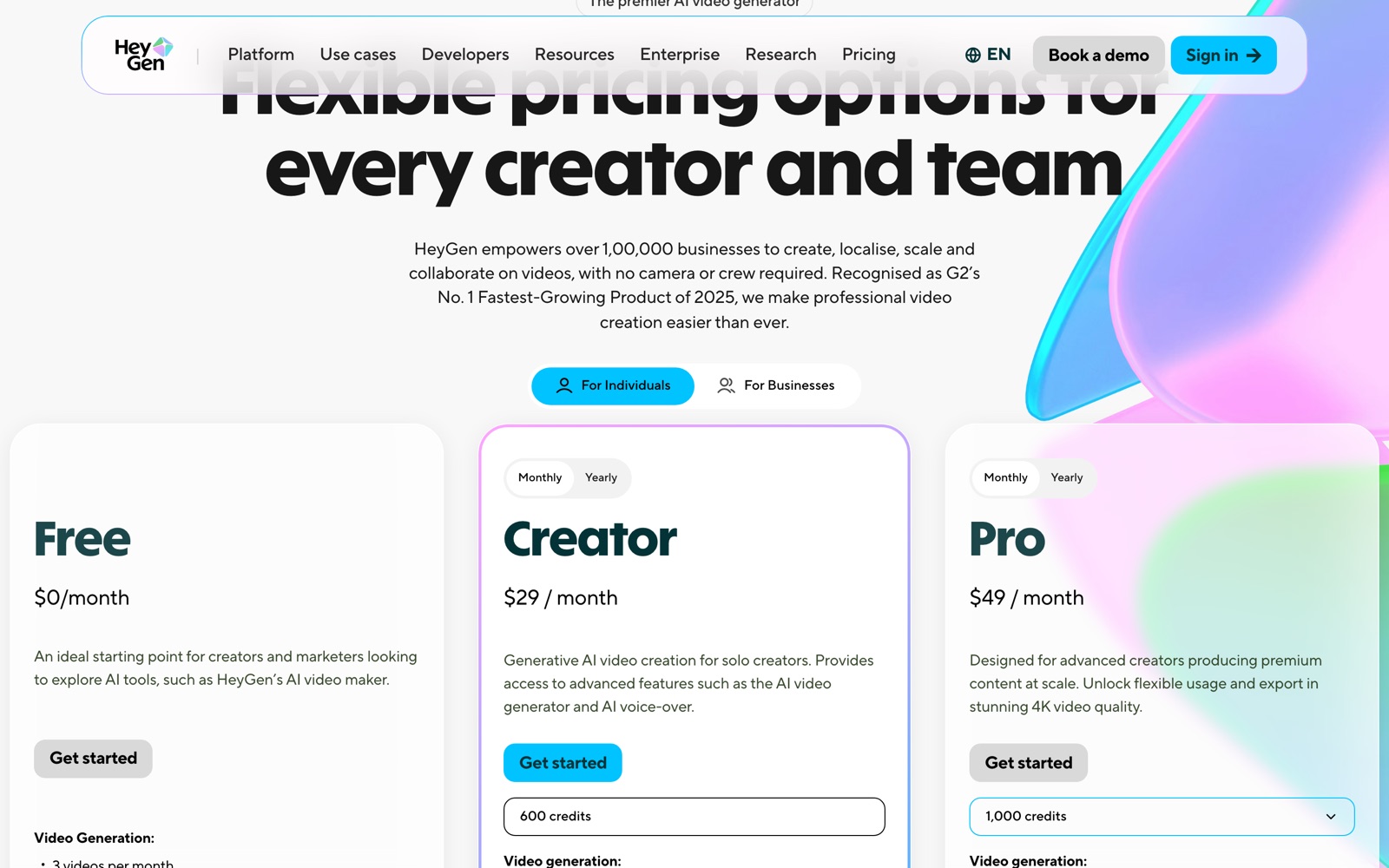
Five plans, one currency. Free has no credits at all — it is counted in videos. Every paid plan sells a monthly credit balance, and higher Pro tiers buy more of exactly the same features.
| Plan | Price | Allowance | Max video length | Export |
|---|---|---|---|---|
| Free | $0, no card | 3 videos a month | 1 minute | Below 1080p, watermarked |
| Creator | $29/month ($24 billed annually) | 600 credits | 30 minutes | 1080p, no watermark |
| Pro | $49 to $4,300/month | 1,000 to 100,000 credits | 30 minutes | 4K |
| Business | $149/month + $20 per seat | Plan credits + packs | 60 minutes | 4K, SCORM |
| Enterprise | Custom | Custom | Unlimited | Custom |
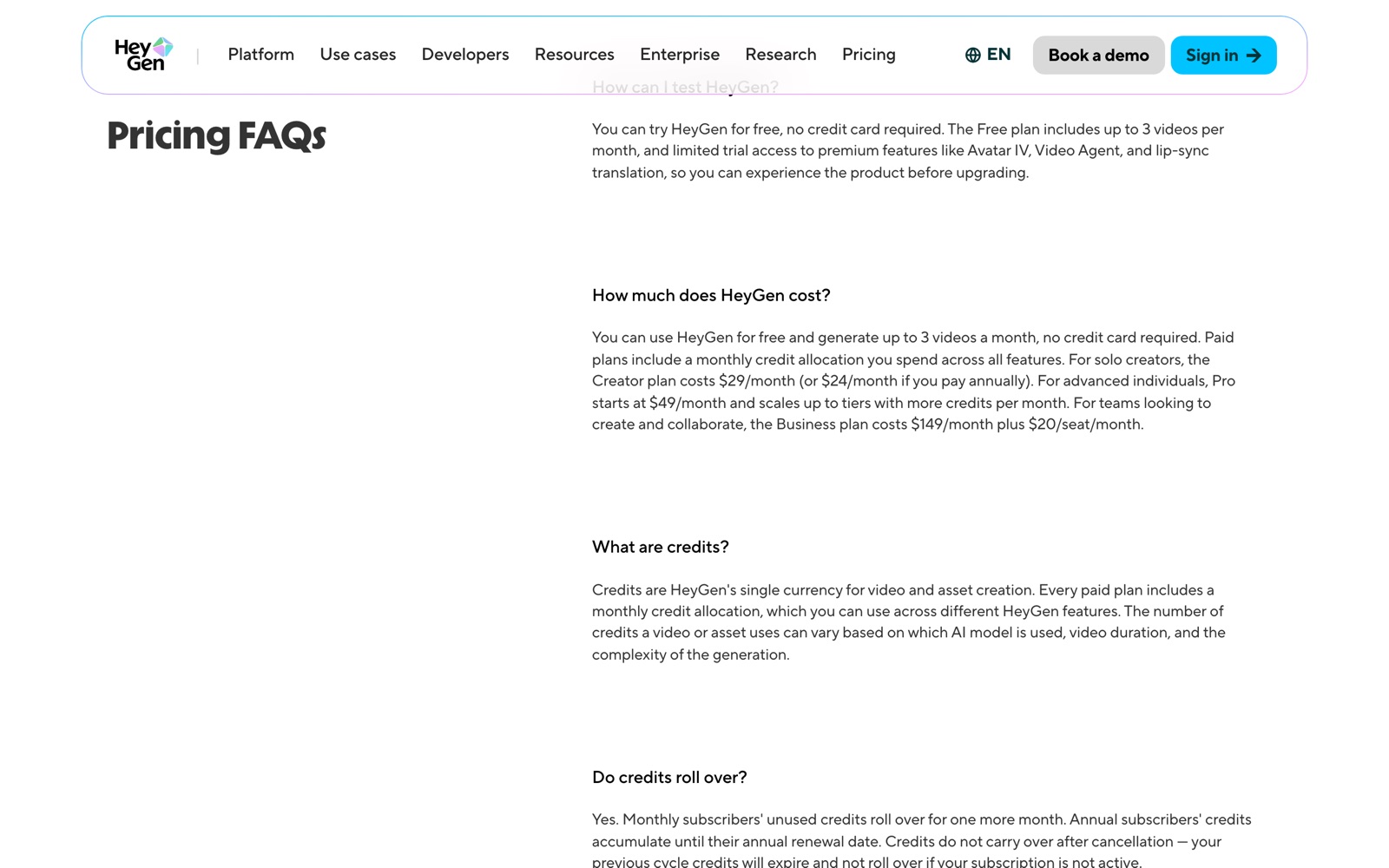
Two details from the pricing FAQs decide more purchases than the table. First, every Pro tier has identical features — only the credit allowance changes, from 1,000 credits at $49 to 100,000 at $4,300. Second, the credit rules: monthly plans roll unused credits over for one extra month, annual plans accumulate them until renewal, and cancelling wipes them. If your usage is bursty, that expiry matters more than the sticker price.
What Creator’s 600 credits actually make
HeyGen’s pricing page never shows the rate card. Its help center does, and it is the whole purchase decision. Rates below are credits per finished minute unless noted, straight from that article:
| Job | Rate | What 600 credits (Creator) make |
|---|---|---|
| Avatar IV photo avatar | 46/min | ~13 minutes a month |
| Avatar IV digital twin | 97/min | ~6 minutes a month |
| Video Agent, standard mode | 40/min | 15 minutes a month |
| Lip-sync translation, Speed | 17/min | ~35 dubbed minutes |
| Translation, no lip-sync | 4/min | 150 minutes |
| Seedance 2.0 clip, any length | 60 (720p) / 150 (1080p) each | 10 clips at 720p, or 4 at 1080p |
Read that table against your own calendar before you pay. A founder posting one 5-minute update a week needs 20 finished minutes a month — about 920 credits with a photo avatar, which breaks Creator and lands on Pro at $49. Creator fits roughly one 3-minute video a week, or a month of short ads. The free plan, meanwhile, is three 1-minute watermarked videos with no 1080p export — enough to test whether your audience accepts an avatar, and nothing more.
One more restriction hides in the model page, not the pricing page: Seedance 2.0 runs on Pro, Business and Enterprise only. Creator accounts keep it solely when bought on or before August 17, 2026 and still active. If cinematic clips are the reason you are buying, Creator is the wrong plan no matter what the credit math says.
All-in costs for three teams
List prices lie by omission: seats, add-ons and the annual discount change the answer. Here are three buyers I see in the founder and marketer stacks, with my arithmetic marked as mine:
| Buyer | Monthly output | Plan that clears it | All-in cost |
|---|---|---|---|
| Solo founder, weekly 5-min update, photo avatar | ~20 min/mo ≈ 920 credits | Pro 1,000 | $49/mo ($588/yr monthly billing) |
| Course creator, 8 short lessons a month, standard Video Agent | ~40 min/mo ≈ 1,600 credits | Pro 2,000-credit tier | $99/mo (per HeyGen’s tier ladder; confirm current tier prices) |
| Agency, 10 client videos + lip-synced dubs in 3 languages | ~50 min generation + ~150 dubbed min ≈ 4,800+ credits, 2 seats | Business + credit packs | $149 + $20 second seat + packs (north of $200/mo) |
The pattern: Creator at $29 covers one short video a week and not much more. Most working founders land on Pro’s $49 base, and teams that translate or seat more than one person land on Business where the meter keeps running through credit packs. Compare that against the agency invoice you are replacing — a single professionally shot explainer still costs more than a year of Creator — and the purchase usually justifies itself. If you make one video a quarter, none of these plans do; the free tier plus a screen recorder wins.
Monthly vs annual: the $60 question
Annual billing cuts Creator from $29 to $24 a month — $348 versus $288 a year, a $60 saving — and it changes the credit rules in your favour: annual credits accumulate until renewal instead of expiring after one extra month. That combination makes annual the right call only when two things are true: you will render every month, and your monthly use fits inside the allowance with room to spare. Accumulated credits forgive a quiet month; they do not forgive a plan that was too small to begin with.
My rule, and it is mine not HeyGen’s: pay monthly for one quarter, read three credit statements, then switch to annual at the tier your heaviest month needed. The $60 you “lose” in quarter one is cheaper than a year of the wrong plan. Pro and Business buyers should do the same math at their own scale, because the expiry rules are identical up the ladder.
We also recommend watching the renewal date itself. Annual credits accumulate until renewal and then reset, so a big project landing in month eleven spends from a full year’s pool while the same project in month one starts from zero. If you know a launch quarter is coming, time the annual switch so the accumulation works for you instead of against you. And if your use is genuinely bursty — a course recorded twice a year, a campaign each quarter — monthly billing with rollover usually beats annual, because you only pay for the months you render.
The API is a separate product
This surprises almost everyone, and it is the answer to half the “heygen pricing explained” searches. Per HeyGen’s API pricing article, the API is pay-as-you-go, standalone — you can buy API credits with no Creator, Pro or Business subscription at all. There are no free API credits (stopped February 2026), old plan-based API credits expired 30 days after purchase, and pay-as-you-go credits last 12 months.
Self-serve rates, from HeyGen’s own pricing breakdown: Avatar III digital twin $0.0167 a second (about $1 a finished minute), Avatar IV photo avatars $0.05 a second, Avatar V $0.0667 a second, from a $5 prepaid wallet. Text-to-speech is the cheapest operation on the platform. Two worked examples, mine: 100 minutes a month of Avatar III twin video through the API costs about $100 with no subscription — cheaper than any plan that clears it. But 1,000 minutes of Avatar IV photo video costs about $3,000 through the API, at which point a Pro credit tier is worth pricing against it.
The time-sensitive line: HeyGen’s new general video model, HeyGen Video, launched September 30 at a promotional $0.01 a second through the end of October, API-only at launch. After the sale the regular rate applies, so anything you build on it needs a price check in November. I would not architect a product’s unit economics on launch-sale pricing.
HeyGen Voice and the $99 voice clone
October brought a second product inside the price list. HeyGen Voice, launched October 9, is the company’s in-house voice model, and it is free inside both the platform and the API — the launch announcement also claims a #1 debut on an independent voice leaderboard, which is HeyGen’s claim, not a verified fact. The paid layer is Professional Voice Clone: a $99-a-month add-on trained on 30 minutes to 3 hours of your speech, with explicit consent required.
For buyers this splits cleanly. Narration, dubbing voices and agent speech cost you nothing extra beyond the video credits — good. Your own voice, cloned at the quality HeyGen reserves for the paid adapter, costs $99 a month on top of whatever plan you hold — a second subscription inside the first. Standard voice cloning (one clone) is already included in Creator, so the $99 only makes sense when the clone itself is the product: a founder’s weekly update avatar, a course voice, a localized spokesperson. Everyone else should ignore it.
Cheaper alternatives with real prices
Three options, each with the number from its own vendor page, checked the same day:
Synthesia, from $29 a month. The closest rival bills credits too, but shows its rate card: about 100 credits per finished video minute. Its pricing page gives Basic free (10 video minutes plus 500 credits a month, watermarked), Starter at $29 monthly ($18 annually, 1,250 credits, roughly 12 extra minutes) and Pro at $89 ($64 annually, 6,000 credits, roughly 60 minutes). No rollover anywhere — allowances reset — which makes Synthesia worse than HeyGen for bursty months and simpler to predict. We read Synthesia’s page the same day, and our take is that the free allowances decide this duel more than the paid tiers: Synthesia hands you 10 video minutes a month free against HeyGen’s 3 watermarked videos, so if your volume is tiny and your scripts are short, you can stay free longer on Synthesia. Once you pay, HeyGen’s rollover and translation breadth pull ahead for multilingual teams. Pick Synthesia for compliance-heavy training; pick HeyGen for translation breadth. The Arcads vs HeyGen comparison covers the ads angle, and the Synthesia alternatives page lists every option we track.
D-ID, Lite listed at $5.90 a month. The cheapest avatar entry I found: D-ID’s own FAQ confirms Lite/Pro/Advanced tiers with monthly credit renewal and no accumulation, a 5-minute video cap and watermarked trial. Confirm the $5.90 figure on d-id.com/pricing before you commit — but even ballpark, it undercuts HeyGen’s floor by 5× for talking-head clips. The trade is scope: D-ID animates a presenter and little else, while HeyGen bundles the editor, translation and dubbed lip-sync.
Arcads, no public price. Our Arcads tool page records it as login-gated pricing with a free trial, built for UGC-style ad creative rather than general presenter video. If ads are the whole job, price Arcads against HeyGen’s per-minute cost for short clips; if you also need training, explainers or translation, HeyGen’s breadth wins and Arcads is not a substitute.
And the free answer: for one video a quarter, film it or screen-record it. Marketers with Typefully-style budgets should note that a $29 Creator plan outlives most ad-hoc editing invoices by month two — the threshold question is videos per month, not production value.
Who should pay for which plan
Our short version, after reading every plan document twice — find your row and stop there:
- Try Free if you have never rendered an avatar video. Three watermarked minutes answer the only question that matters: does your audience accept it.
- Pay Creator ($29, or $24 annual) if you make up to one short video a week with a photo avatar and need no Seedance clips. Re-check the credit statement after month one.
- Pay Pro (from $49) if you post weekly or longer, need 4K, Seedance, editable translated scripts or API-scale credits. Same features at every tier — buy the credit level, not the badge.
- Pay Business ($149 + seats) if two or more people collaborate, you need SSO, comments, interactive video or SCORM, or you burn through credit packs.
- Use the API wallet if you generate video programmatically. Under ~100 Avatar III minutes a month it beats every subscription; past that, price it against a Pro tier.
- Skip paid entirely if your videos depend on a real face, real emotion or one quarterly update. No credit system beats free.





 ChatGPT
 Claude
 Perplexity
 Grok
Grok