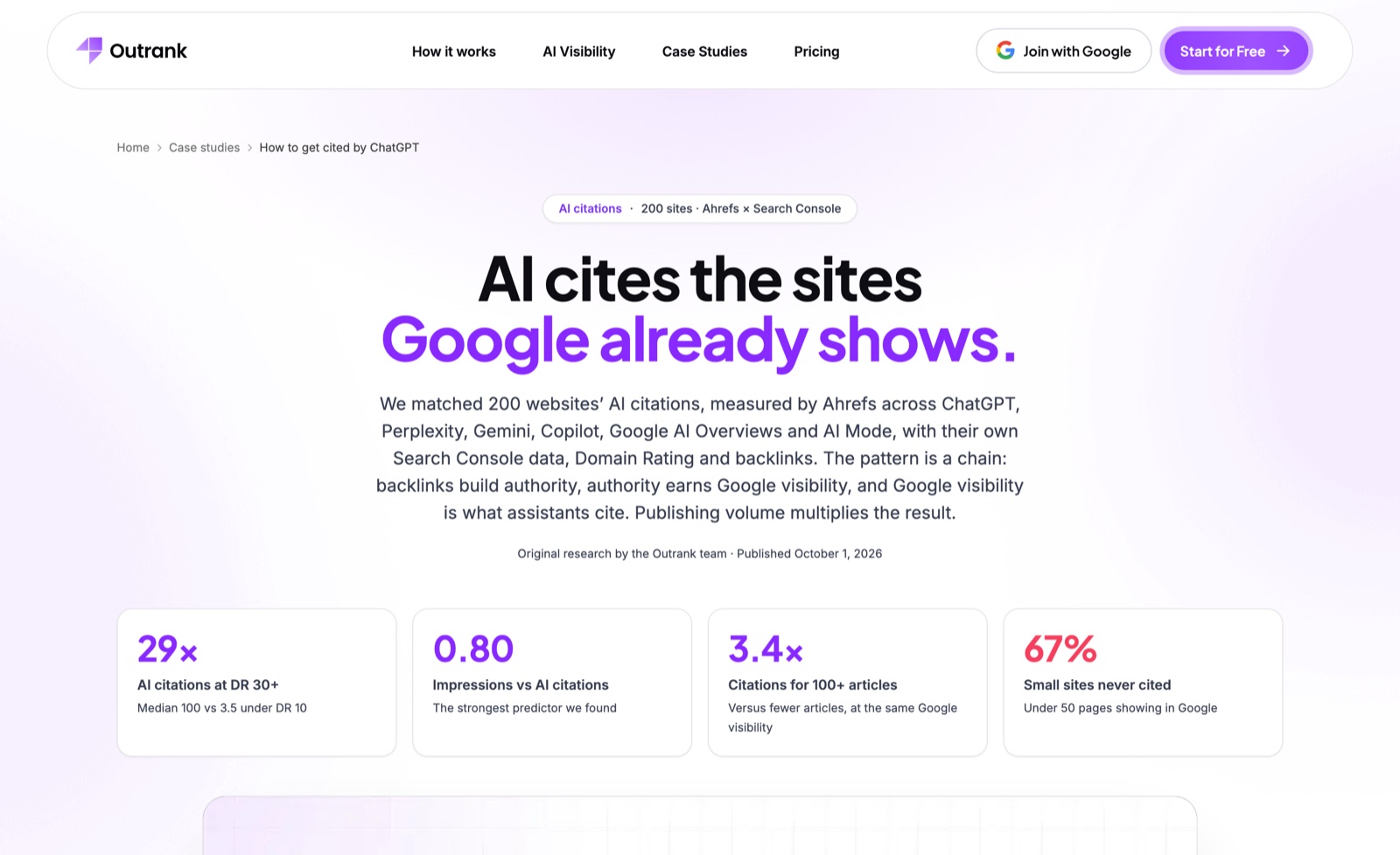
If you want to get cited by ChatGPT, your Domain Rating is the wrong number to stare at. ChatGPT never looks it up; it runs a web search and quotes what that search returns. In a 200-site study, Google impressions predicted AI citations far better than Domain Rating did (0.80 against 0.43), and at equal impressions DR added almost nothing. DR still matters, but only because it helps you rank. The work is getting shown in search for many questions, then being worth quoting.
We built this guide from two studies and two sets of vendor documentation, all read on October 5, 2026: Outrank’s 200-site citation study, Ahrefs’ 75,000-brand study, OpenAI’s crawler docs and Google’s page on AI features. We didn’t run our own citation tracking. One disclosure up front: Outrank sells an AI SEO agent, and minylist earns a commission when you sign up through our links. So the main dataset here comes from a vendor with a product to sell, and we’ve read it with that in mind. What this post adds over the study page: a second, independent dataset, the caveats in one place, and a checklist that doesn’t depend on buying anything.
What the Outrank study measured, and who ran it
Outrank took 200 of its own customers’ websites, picked at random, 40 from each fifth of the traffic distribution so tiny and large sites count equally. Every site had Google Search Console connected and at least 500 impressions in the previous 28 days. It then pulled each site’s AI citations from Ahrefs for September 2026, across ChatGPT, Perplexity, Gemini, Microsoft Copilot, Grok, Google AI Overviews and AI Mode. That came to 53,068 citations, a median of 43 per site; 17 sites had none.
The comparison is a Spearman rank correlation: does the site that ranks higher on one measure also rank higher on the other? A 1 means a perfect match, 0 means no relationship. Rank correlation suits this data because the gap between a hobby blog and a site with 300,000 monthly impressions would swamp an ordinary average.
Two things to keep in mind as you read the numbers. Every site is an Outrank customer, publishing Outrank’s articles and trading links through Outrank’s exchange, so these aren’t random websites. And “AI citations” here means all six assistants added together, not ChatGPT alone. Outrank titled the study “How to get cited by ChatGPT”, but ChatGPT supplied under 5% of the citations it counted. We come back to that below.
Does Domain Rating matter for AI citations?
Yes, up to a point, and the point arrives sooner than most link-building pitches suggest.
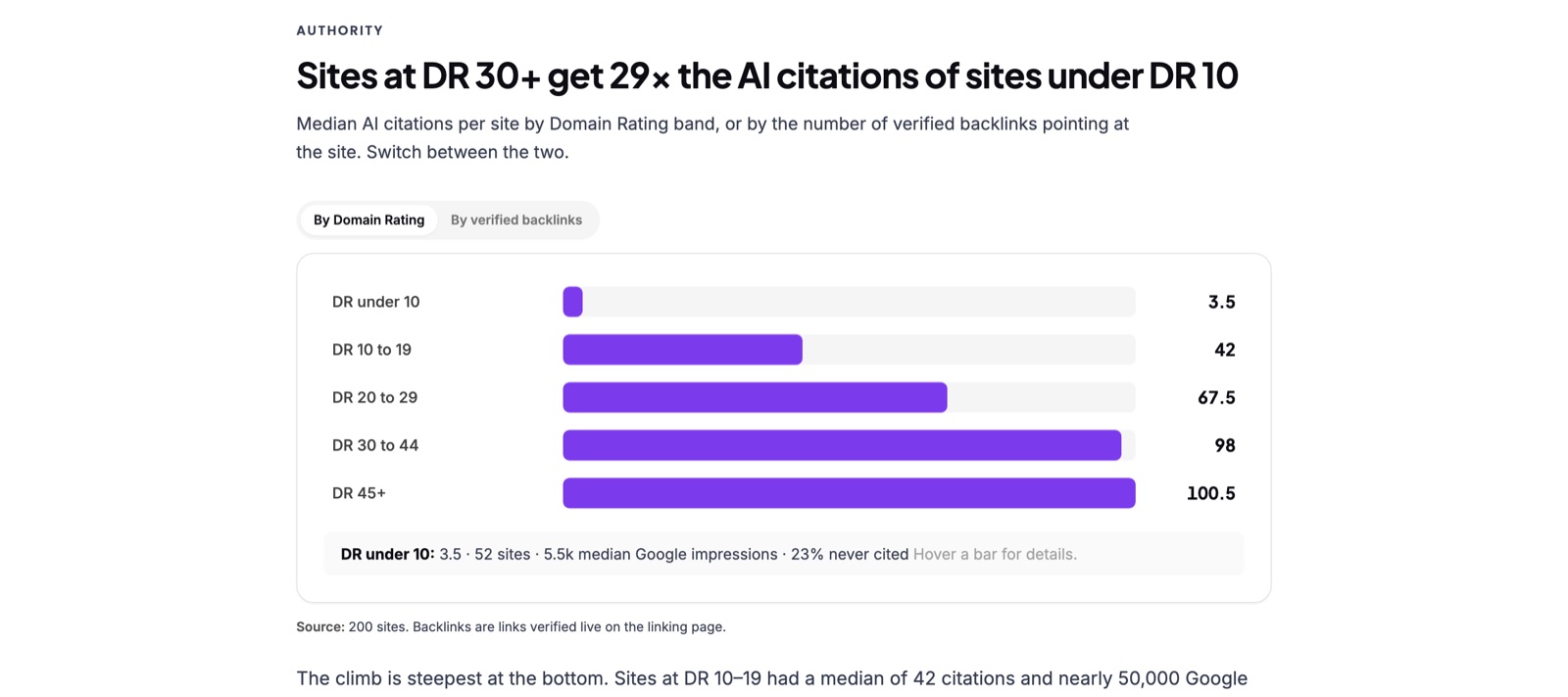
Look at where the curve bends. Sites under DR 10 had a median of 3.5 AI citations. Moving to DR 10 to 19 took the median to 42, a twelvefold jump. From there the gains shrink: 67.5 at DR 20 to 29, 98 at DR 30 to 44, and then 100.5 for sites at DR 45 and above. The 20 sites with the highest authority got almost exactly the same median as the 45 sites in the band below them. Past roughly DR 30, more Domain Rating barely moved AI citations in this data.
Outrank’s headline number, “29× the AI citations at DR 30+”, is real, but it’s measured against sites under DR 10, the weakest group in the sample. It tells you that having no authority at all keeps you out of AI answers. It doesn’t tell you that climbing from DR 35 to DR 60 will pay off.
The study also explains why Domain Rating works at all. It lays out a chain, with a rank correlation on each link:
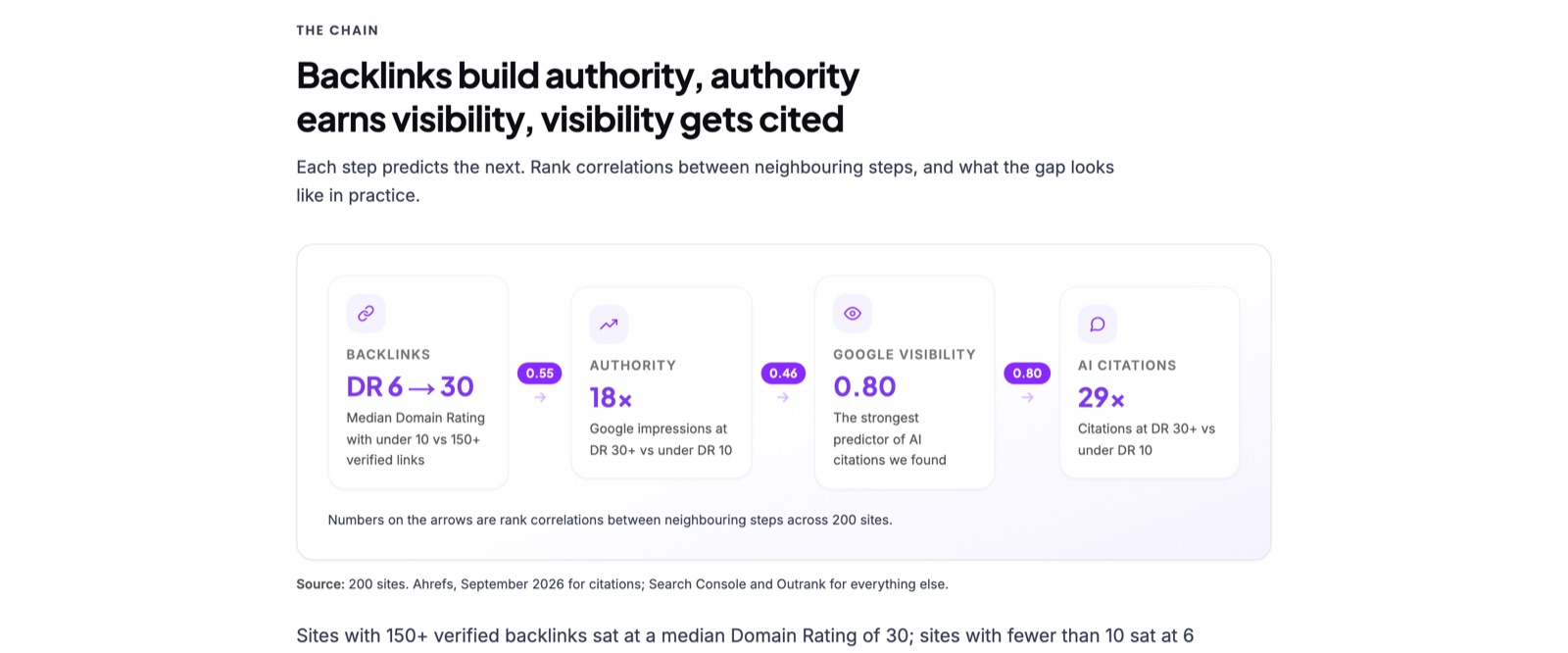
Backlinks lift Domain Rating (0.55). Domain Rating lifts Google impressions (0.46). Google impressions line up with AI citations (0.80). Each link in the chain is weaker than the last one, which matters: a correlation of 0.46 between authority and impressions means plenty of high-DR sites get few impressions, and plenty of modest sites get many. Authority is one way to earn visibility, not a guarantee of it.
Then comes the number the whole “ChatGPT doesn’t care about your DR” idea rests on. When Outrank compared sites that Google already showed about equally often, Domain Rating’s own link to citations dropped to a partial correlation of 0.12. That’s close to nothing. Outrank’s own reading is careful: authority “does its work by earning the impressions in the first place.” That’s how we’d put it too. DR is an input to search visibility, and search visibility is what the assistants see.
What predicts AI citations better than Domain Rating
Here’s the full ranking from the study, every factor Outrank measured against total AI citations:
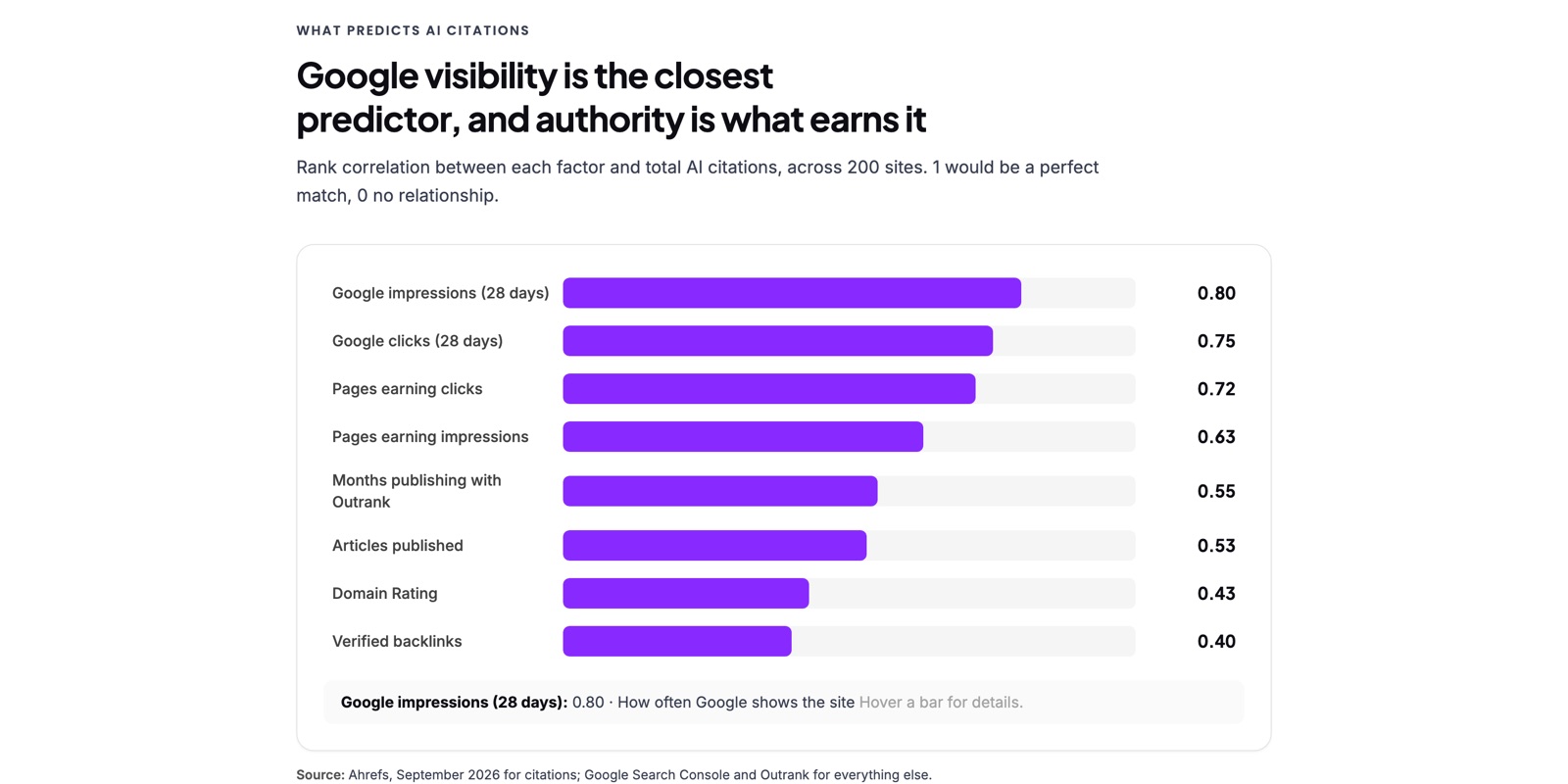
The top four are all things you read in Google Search Console, not in an SEO tool’s authority score. Impressions over 28 days lead at 0.80, followed by clicks (0.75), the number of pages earning clicks (0.72) and the number earning impressions (0.63). Domain Rating comes seventh. Verified backlinks come last.
Breadth shows up twice. When Outrank grouped sites by how often Google showed them and then split each group by how much they’d published, the sites with 100 or more articles collected 2.3 to 3.4 times the citations of sites with fewer, at the same visibility. In the most visible third, that was a median of 345 citations against 101. Outrank’s explanation is that more pages give an assistant more distinct answers to pull from: the median cited site had only 2.5% of its Google-visible pages quoted anywhere, and you can’t know in advance which 2.5% it will be.
There’s a floor, too:
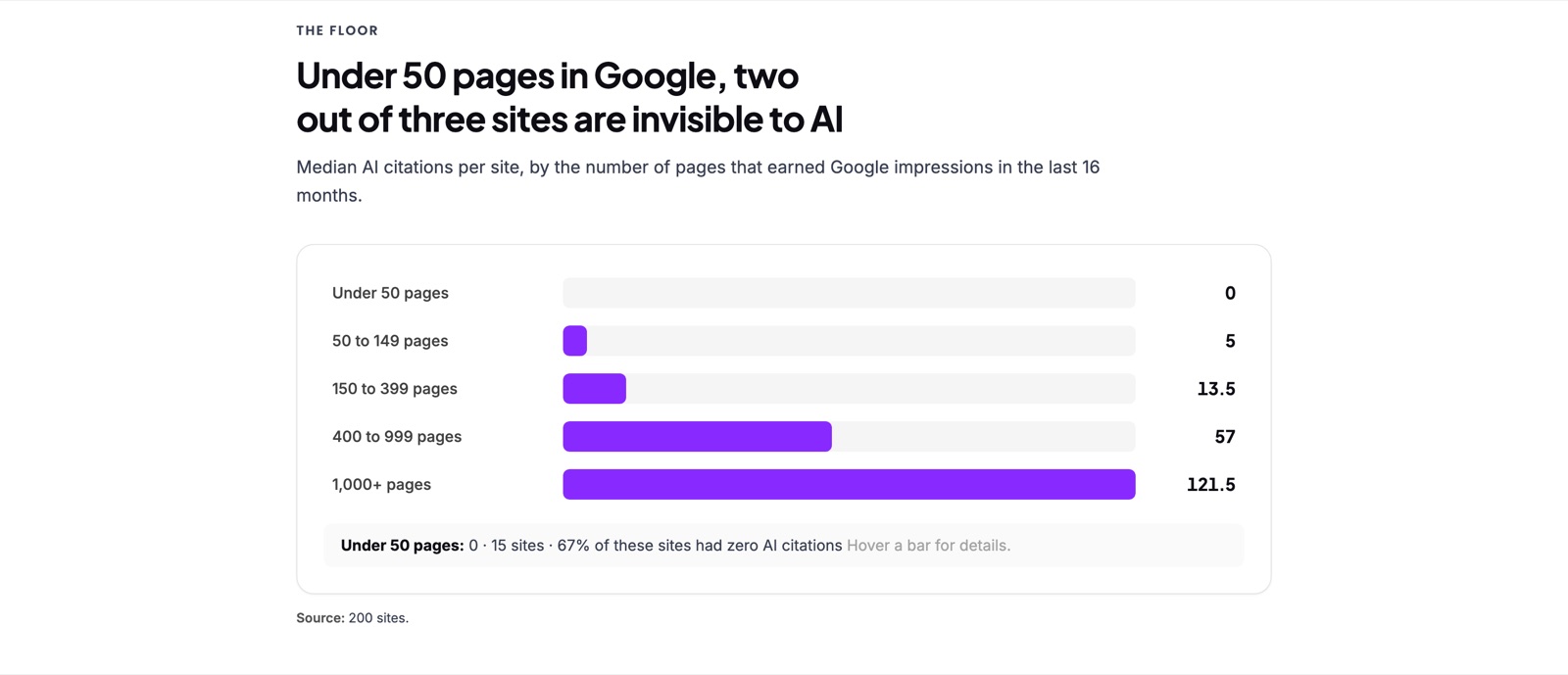
Sites with fewer than 50 pages earning impressions had a median of zero citations, and 67% of them had none at all. Not one of the 110 sites with 400 or more visible pages went uncited. Treat the bottom band carefully, though: it holds just 15 sites, so that 67% is about ten websites.
Ahrefs’ 75,000-brand study points the same way
A vendor study is one data point. The useful check is whether someone with a different sample, and a different thing to sell, finds the same pattern. Ahrefs published one in December 2025: 75,000 brands, all with a Domain Rating above 40, scored on how often ChatGPT, Google AI Mode and AI Overviews mention them.
| Factor | ChatGPT | AI Mode | AI Overviews |
|---|---|---|---|
| YouTube mentions | 0.737 | 0.740 | 0.712 |
| Branded web mentions | 0.664 | 0.709 | 0.656 |
| Branded anchors | 0.511 | 0.628 | 0.527 |
| Branded search volume | 0.352 | 0.466 | 0.392 |
| Domain Rating | 0.266 | 0.285 | 0.326 |
| Number of pages on the site | ~0.19 | ~0.19 | ~0.19 |
Correlations with AI brand visibility, from Ahrefs’ study by Louise Linehan, December 12, 2025.
For ChatGPT specifically, Domain Rating scored 0.266. People talking about the brand, on YouTube and across the web, scored more than twice that. Since every brand in Ahrefs’ sample already had DR 40 or higher, this is the high-authority end of the curve that Outrank’s data showed flattening out. The two studies agree on the part that matters for most readers: once you have a decent base of authority, more Domain Rating stops being the thing that gets you into AI answers.
They don’t agree on everything. Ahrefs found the number of pages on a site barely mattered (about 0.19), while Outrank found pages earning clicks and impressions mattered a lot (0.72 and 0.63). They measured different things, though. Ahrefs counted brand mentions for large companies; Outrank counted links to small and mid-sized sites. And Ahrefs counted every page a site has, while Outrank counted only pages Google actually shows. A big brand doesn’t need 400 blog posts for ChatGPT to know its name. A small SaaS with no brand recognition does need pages that rank, because a search result is the only way the assistant will find it.
Where ChatGPT fits: 4.8% of the citations
Outrank also split its 53,068 citations by assistant:
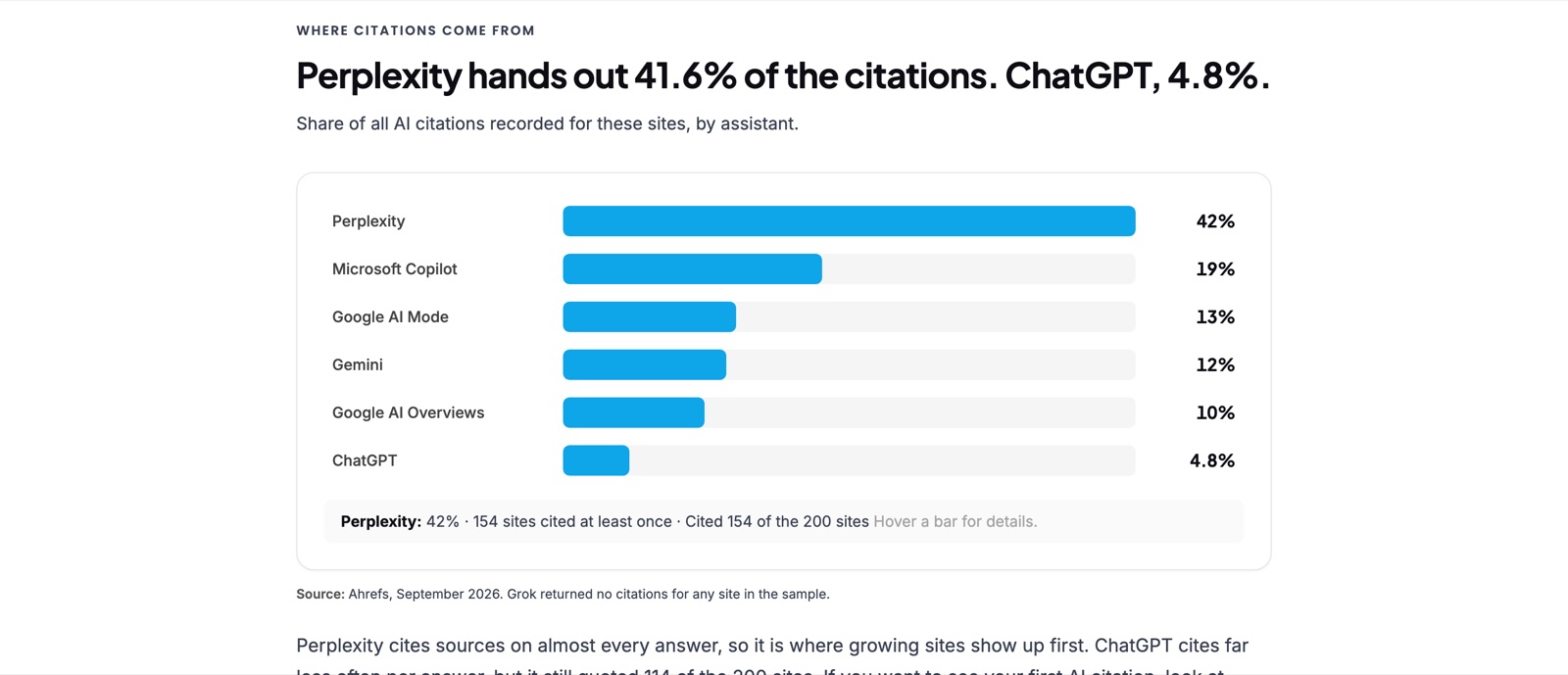
Perplexity handed out 41.6% of all the citations; ChatGPT, 4.8%. Outrank’s explanation is how the products work: Perplexity cites sources on almost every answer, while ChatGPT cites far less often per answer. ChatGPT still cited 114 of the 200 sites at least once, so it isn’t ignoring small sites; it just cites less often per answer. Grok returned no citations for any site in the sample.
That changes how you should read the study’s title. The correlations cover all six assistants pooled, and Perplexity and Copilot supply most of the data. No ChatGPT-only breakdown is published. If you’re checking whether your work is paying off, Outrank’s own advice applies: you’ll usually see your first citations on Perplexity and Copilot before ChatGPT.
On the ChatGPT side, one technical setting decides whether you’re eligible at all. OpenAI runs separate crawlers for separate jobs, and its crawler documentation is plain about it: OAI-SearchBot “is used to surface websites in search results in ChatGPT’s search features,” and “sites that are opted out of OAI-SearchBot will not be shown in ChatGPT search answers.” GPTBot is a different crawler that collects training data. You can block GPTBot and still allow OAI-SearchBot, but a blanket rule against every AI bot blocks both. OpenAI says robots.txt changes take about 24 hours to reach its systems.
How to get cited by ChatGPT: a checklist from the data
None of these steps needs a paid tool. They’re ordered by what the two studies suggest gives you the most per hour.
- Let the crawlers in. Open your robots.txt and confirm OAI-SearchBot isn’t disallowed, either by name or by a
User-agent: *block. Do the same for Googlebot and Bingbot. If your CDN or firewall has an AI-bot blocking setting switched on, check which crawlers it actually stops. - Get indexed in Google first. Google’s AI features page says a page needs to be “indexed and eligible to be shown in Google Search with a snippet” to appear as a link in AI Overviews or AI Mode, and that there are “no additional requirements” beyond that: no llms.txt, no special markup. The other assistants run their own searches, but the study’s top predictor was Google visibility, so start there.
- Clear the 50-page floor. If Search Console shows fewer than 50 pages earning impressions over the last 16 months, that’s your bottleneck. You want pages that answer specific questions your buyers ask, one question per page, not more posts on topics you’ve already covered.
- Track impressions as your AI metric. Outrank’s data puts Google impressions at 0.80 with AI citations. You already have that number for free in Search Console. If it’s climbing month over month, assistants are more likely to be finding you, and you don’t need a separate tracking tool to tell.
- Build links until about DR 30, then shift your effort. Going from under DR 10 to the teens was the biggest jump in the study. Above 30, the citation curve went flat. If you’re already there, put the next hour into steps 3 and 6.
- Get your brand mentioned where people talk. Ahrefs’ strongest factors were YouTube mentions and branded web mentions. That means being discussed in videos, podcasts, newsletters and threads, not only linked. A founder posting useful threads on X and LinkedIn with a scheduler like Typefully builds mentions; so does a short explainer video, which HeyGen can produce if you won’t go on camera yourself.
- Write answers that can be quoted on their own. An assistant quotes a passage, not a page. Put the direct answer in the first two sentences under each heading, with the number in it. This post does exactly that, if you want an example.
Steps 1 and 2 are a single afternoon. Steps 3 and 6 are months of steady work, and they’re where most of the result comes from.
A worked example: a 30-page SaaS site at DR 12
Suppose you run a small B2B SaaS. Hypothetical numbers: 30 pages earning impressions, DR 12, about 3,000 impressions a month in Search Console, and you’ve never seen your domain cited by an AI assistant.
On Outrank’s charts, you sit in the worst spot on two counts. Thirty pages puts you under the 50-page floor, where two out of three sites got zero citations. DR 12 puts you in the 10 to 19 band, which had a median of 42 citations, but those sites also had a median of nearly 50,000 impressions, more than ten times yours. Your problem isn’t authority. It’s that Google barely shows you.
So you’d skip the reflex of buying links. Over the next six months, you’d write 40 to 60 pages that each answer one question a buyer asks before they buy: “how to do X in Y”, “X vs Y for small teams”, “what does Z cost”. A cheap AI writer like Rytr can produce first drafts, but every one needs a human pass with your real numbers in it, or it won’t rank. You’d watch two numbers in Search Console: pages earning impressions, and total impressions. When the first passes 100 and the second grows month over month, check Perplexity for your brand and main topics. That’s where the study says the first citations tend to appear.
Some of that writing will fail. That’s normal; the median cited site has only 2.5% of its pages quoted anywhere.
Where these numbers can mislead you
We’d trust the direction of these findings more than any single figure. Here’s why.
- It’s correlation. Established sites have more of everything: links, authority, articles, impressions and citations. Outrank grouped sites by impressions to control for size, but nothing in the data controls for brand strength, niche or writing quality. Outrank says this on its own page, to its credit.
- The sample is Outrank’s customers. They all publish Outrank’s articles and trade links in its exchange. Outrank notes that in its exchange, publishing more and receiving more links go together (0.79), so the article effect and the link effect are hard to pull apart.
- One measuring stick. Every citation count comes from Ahrefs, which tracks a large but fixed set of prompts. A site can be cited for questions outside that set and never show up.
- One week. Citations and Search Console data come from the same snapshot. Nobody yet knows how long citations lag behind new rankings.
- Small bands. The under-50-pages group is 15 sites. The DR 45+ group is 20.
And keep the obvious in view: the study comes from a company that sells daily articles and backlinks, and its conclusion (“build authority, publish wide”) matches its product exactly. That doesn’t make it wrong. Ahrefs’ independent numbers point the same way on Domain Rating. But it’s a reason to treat “up to 3.4× more citations for 100+ articles” as a pattern, not a promise.
Where Outrank fits, and when to skip it
Outrank automates steps 3 and 5 of the checklist above: it researches keywords, writes and publishes an article a day to your CMS, and places backlinks through an exchange where you host links in your own articles to earn credits for links to yours. Prices from Outrank’s pricing page on October 5, 2026:
| Plan or add-on | Price | What you get |
|---|---|---|
| Organic Growth | $99/month or $999/year | 30 articles a month auto-published, keyword research, backlink exchange, AI images, unlimited users |
| 60 articles a month | +$85/month | Two articles a day for one site |
| 90 articles a month | +$160/month | Three articles a day for one site |
| Backlink Premium | $199/month | Extra monthly backlink credits |
| Human Curated | $1,399/month | Editors review and fact-check every article |
Outrank lets you see its keyword research and generated articles before you pay; trial articles carry a watermark. Sites 2 to 4 get 10% off, and Outrank’s affiliate newsletter on October 5 said one Enterprise backlink plan can now cover up to three products.
It suits you if you have a site stuck under the 50-page floor, you know what your buyers search for, and you don’t have the hours to write 30 pages a month. Skip it if you have a writer or the time to write well yourself, since the free checklist above covers the same ground; if your niche punishes thin content (medical, legal, finance), where you’d need the $1,399 human tier to be safe; or if you’re already well past DR 30 with hundreds of ranking pages, where the data says more of the same won’t move citations much and brand mentions are the better bet. We’d also tell you to read a dozen of its sample articles against your own standard before you let it publish to your domain every day.
Want the rest of the tools for running content and growth with a small team, one per job? See the must-have tools for marketers, or the founders’ stack if you’re doing all of this yourself. For more on AI writing tools, browse the AI writing category.





 ChatGPT
 Claude
 Perplexity
 Grok
Grok