




The best email marketing for creators, for most people reading this, is Kit: it’s free up to 10,000 subscribers, and its $39-a-month Creator plan adds the automations that sell a course or a book. Pick beehiiv if your newsletter is a publication with ads and paid tiers, MailerLite if you need automation on a small list for the least money, Substack to start free inside a reader network, and Mailchimp if you also run a store.
We checked every price, free-plan cap and sales fee below on the vendors’ own pricing pages and help centers on October 5, 2026. None of the five was tested hands-on for this post; these are their published plans and fees, and where a page didn’t show us something (Mailchimp’s US prices, for one), we say so. One disclosure up front: we earn a commission if you buy Kit through our links. It’s ranked first for the reasons in its section, and we name the cases where you should pick something else.
What this ranking adds to the vendors’ own pages: their free-plan caps, paid entry points and fees on one table, and a pick per job, since a novelist with a launch list and a daily-news writer need different tools.
How we chose the best email marketing for creators
A creator’s email tool does four jobs: collect subscribers, send newsletters, run automated sequences that sell, and take payment for paid content or products. We ranked on how each platform handles those jobs for a person or a small team, using five checks:
- Free plan size. How many subscribers you can reach before paying anything.
- The price of automation. What the cheapest plan with sequences or automations costs, since that’s the point where most creators start paying.
- Fees on sales. What the platform takes from a paid subscription or product, on top of Stripe.
- Send caps and seats. Whether the plan limits emails per month or logins.
- What it’s built around. A publication, a store, or a creator selling their own work.
Prices are the vendors’ list prices in USD for 1,000 subscribers unless we say otherwise.
We left some well-known names out on purpose. Klaviyo, ActiveCampaign and Brevo come up in “ConvertKit vs” searches, but in our reading each aims at a different buyer than a solo creator: Klaviyo at ecommerce stores, ActiveCampaign at sales-led businesses that want a CRM, and Brevo at transactional and multichannel sending. Flodesk sells mainly on email design. We didn’t price any of them for this post, so none is ranked here; if you run a store, Klaviyo deserves a look alongside Mailchimp before you decide. All five price by list size, so check the slider on each page at your own number before you choose.
1. Kit: best for creators who sell something
Kit, formerly ConvertKit, is built for authors, coaches, course creators, YouTubers and podcasters whose audience is the business. It collects subscribers with forms and landing pages, sends newsletters, runs Visual Automations and email sequences, and sells digital products, paid newsletters and subscriptions from the same account.
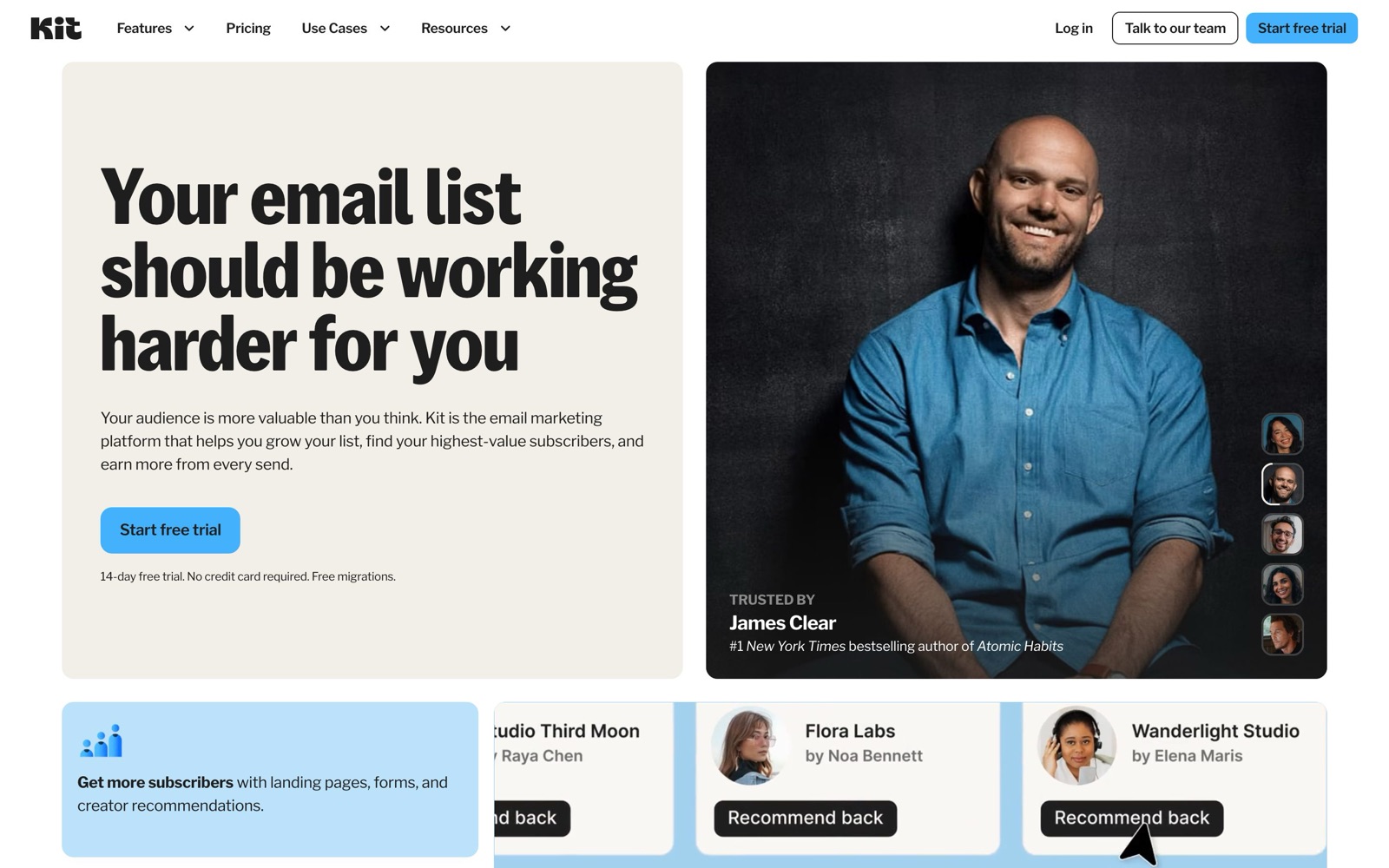
Price. Free costs $0 for up to 10,000 subscribers, with unlimited landing pages, forms and broadcasts. Creator is $39 a month billed monthly at 1,000 subscribers ($390 a year billed yearly) and adds unlimited automations and sequences, integrations, RSS-to-email and the Kit MCP for AI assistants. Pro is $79 a month and adds unlimited users, engagement scoring and deliverability reports. There are no send caps on any plan, according to Kit’s pricing FAQ. Sales cost 3.5% + 30¢ each, card processing included. Our Kit pricing breakdown has every tier up to 95,000 subscribers.
Why it’s first. No other platform here lets you reach 10,000 subscribers for free, and Kit’s paid plans are built around the thing creators pay for: a welcome sequence that leads into an offer, tags that follow each subscriber’s clicks and purchases, and a checkout in the same tool. The Recommendations network, where Kit newsletters suggest each other at sign-up, gives you a growth channel that isn’t paid ads.
The catch. Automations aren’t on the free plan, so the first paid month usually arrives with your first sequence. The price climbs with list size: Creator is $139 a month at 10,000 subscribers billed monthly. Creator has two user seats; a third person means Pro. And Kit Commerce pays out through Stripe connected accounts, which Kit’s terms don’t list for some countries, India among them.
Pick something else if your newsletter is a media product with ads and a website (beehiiv), or you want automations on a tiny budget and a small list (MailerLite). More detail is on the Kit tool page.
2. beehiiv: best for newsletters run as a publication
beehiiv is a newsletter platform with a website, podcast hosting, an ad network and paid subscriptions built in. Where Kit is built around a creator’s offers, beehiiv is built around the publication itself: posts live on a site, readers can browse an archive, and advertisers can buy placements.
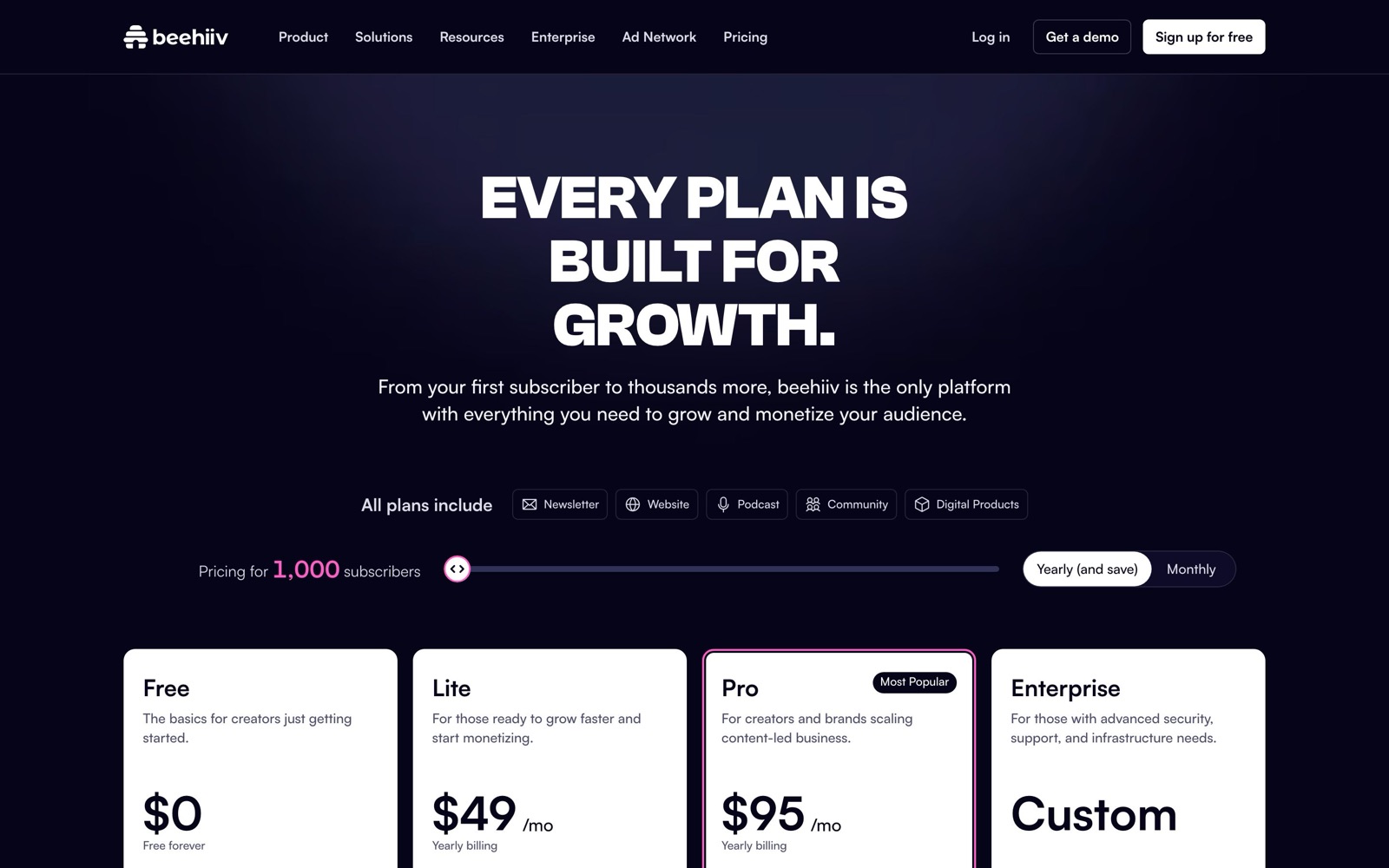
Price. Free covers up to 2,500 subscribers with unlimited sends, landing pages and the recommendation network. Lite is $49 a month billed yearly at 1,000 subscribers and adds paid subscriptions, ad monetization, automations, polls, A/B tests and the beehiiv MCP. Pro is $95 a month billed yearly and removes beehiiv branding. beehiiv’s pricing page says it takes 0% of paid subscription and digital product revenue, so you pay only Stripe’s 2.9% + $0.30.
Why it’s here. If paid subscriptions are the main income, beehiiv’s 0% take rate beats Kit’s 3.5% + 30¢ on every payment, and the ad network is something Kit only approaches through its sponsorship marketplace. The website is a real publication site, not just landing pages.
The catch. Automations start on Lite at $49 a month billed yearly, $10 more than Kit Creator billed monthly and with a free tier a quarter the size of Kit’s. If you don’t need the website or ads, you’re paying for parts you won’t use.
Pick something else if you sell courses or coaching more than subscriptions (Kit), or you just want to publish free (Substack).
3. MailerLite: best cheap option for small lists
MailerLite is a general email marketing tool with websites, landing pages, sign-up forms, automations and a small digital-product shop. It’s the cheapest way here to get real automations on a list of a few hundred people.
Price. Free covers up to 250 subscribers and 2,500 emails a month, with 3 automations, one website and one landing page, and two seats. Comfort is $12 a month ($10.80 billed yearly) for 500 subscribers, 5,000 emails a month, 50 automations and three seats. Power is $25 a month ($22.50 billed yearly) and lifts sends and seats to unlimited. MailerLite’s pricing page also lists an MCP for Claude and ChatGPT on every plan, Free included.
Why it’s here. At 500 subscribers, MailerLite gives you automations for $12 a month, where Kit’s Creator plan is $39 at 1,000 subscribers. If you’re starting a list for a small product and want a welcome sequence on day one, it’s the most affordable option in this list.
The catch. The free plan stops at 250 subscribers, and Comfort caps sends at 5,000 a month. A weekly newsletter to 500 people uses about 2,000 of those, which is fine; a daily one isn’t. Its creator selling tools (digital products and bookings) are capped at five on Comfort. As the list grows past a few thousand, the gap to Kit narrows.
Pick something else if you have more than 250 subscribers and don’t need automations yet: Kit’s free plan covers you up to 10,000.
4. Substack: best free way to start publishing
Substack is a publishing platform and a reader app at once. You write posts that go out by email and live on a Substack page, readers subscribe inside the app, and Substack’s network recommends publications to each other.
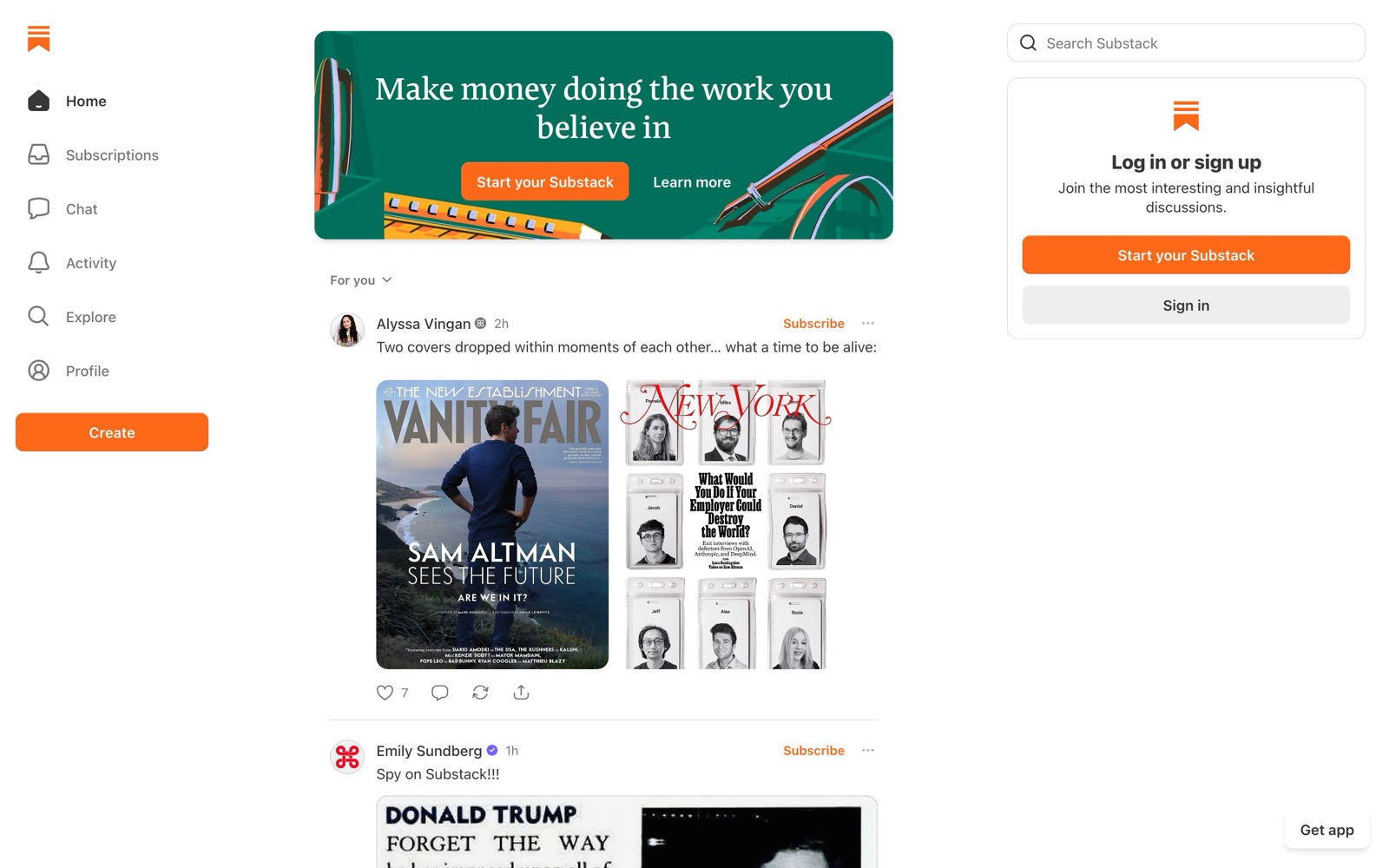
Price. Publishing is free at any size. If you turn on paid subscriptions, Substack’s help center says it keeps 10% of subscription revenue, and Stripe charges its own fees: 2.9% + $0.30 per US card payment and 0.7% for recurring billing. On a $10 monthly subscription that’s about $1.66 per payment, by our arithmetic, against $0.65 on Kit and $0.59 on beehiiv.
Why it’s here. It’s the only option where a free account comes with an audience: the app and recommendations put your posts in front of readers you didn’t bring yourself. For a writer testing whether anyone wants to read them, nothing is faster to start.
The catch. Substack’s own pages sell publishing and paid subscriptions; they don’t offer the automated sequences, tagging or landing pages a launch funnel runs on. And the 10% cut grows with your paid list: at 1,000 readers paying $10 a month, it’s $1,000 a month to Substack before Stripe.
Pick something else if you want to sell anything besides subscriptions, or want automated emails (Kit or MailerLite).
5. Mailchimp: best if you also run a store
Mailchimp is email and SMS marketing for small businesses and online stores, owned by Intuit, with Shopify, WooCommerce and Square among the integrations it lists as most popular. For a creator who also sells physical products through Shopify or WooCommerce, it covers both audiences in one tool.
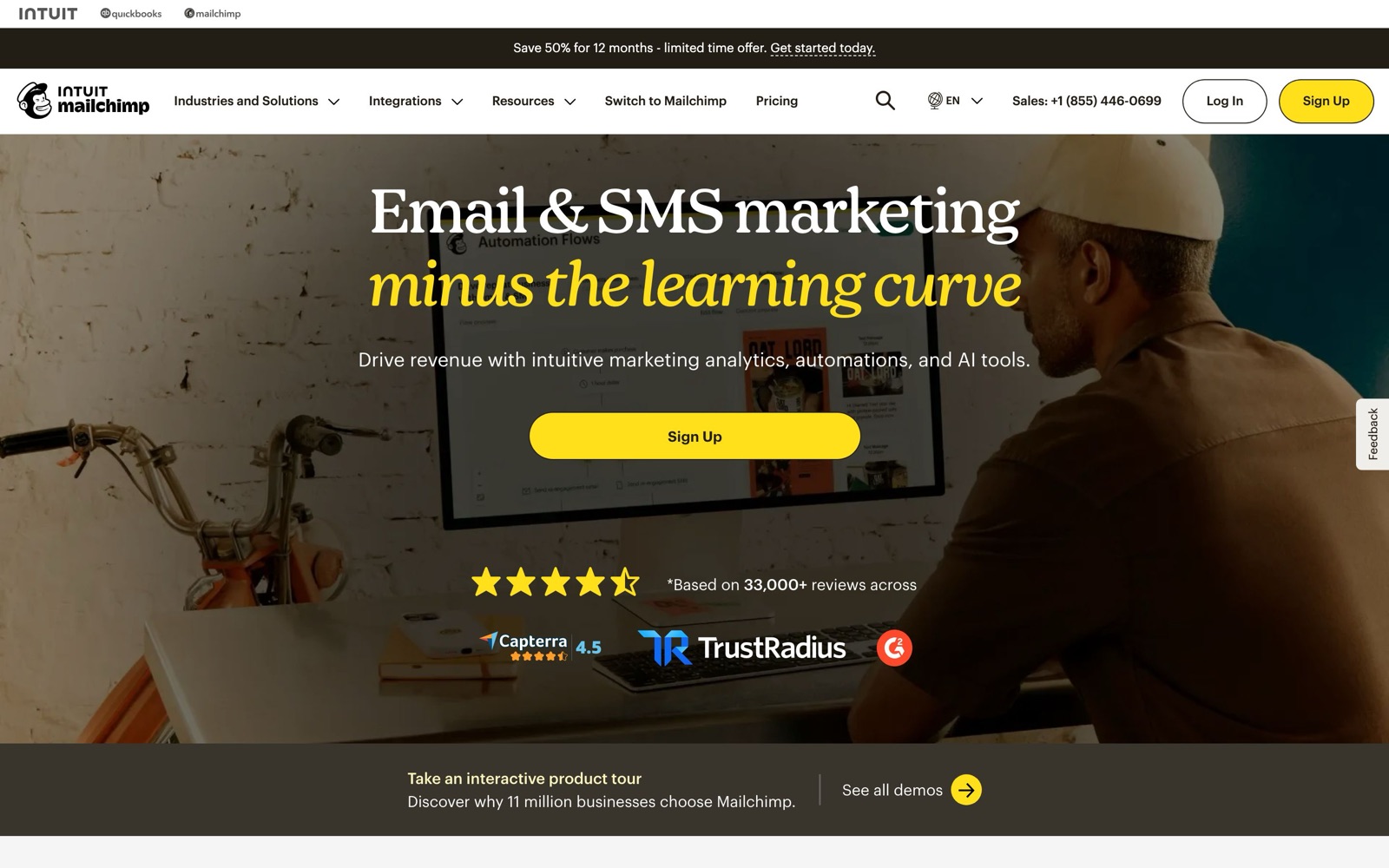
Price. Free covers 250 contacts and 500 sends a month (250 a day) with one seat, per Mailchimp’s help center. Paid plans cap monthly sends at a multiple of your contact limit: 10 times on Essentials, 12 on Standard and 15 on Premium, with 3, 5 and unlimited seats. Mailchimp sets prices by region; from India its page showed us local USD prices that aren’t US list prices, so check its pricing page from where you’ll pay.
Why it’s here. Store integrations and SMS in the same account suit a creator whose income is merch or physical goods. For that reader, Mailchimp’s ecommerce depth matters more than Kit’s creator tooling.
The catch. The free plan is the smallest here, every paid plan caps sends, and seat limits are tighter than Kit’s Pro. For a creator selling digital products, it’s more tool than you need. We list Mailchimp’s plans beside Kit’s on our Mailchimp alternatives page.
Pick something else if you sell digital products, courses or a newsletter (Kit, beehiiv or Substack all fit better).
Email marketing for creators, compared
| Kit | beehiiv | MailerLite | Substack | Mailchimp | |
|---|---|---|---|---|---|
| Free plan | Up to 10,000 subscribers | Up to 2,500 subscribers | Up to 250 subscribers, 2,500 emails/mo | Free at any size | 250 contacts, 500 sends/mo |
| Cheapest plan with automations | $39/mo (1,000 subs, monthly) | $49/mo (Lite, yearly billing) | Free (3 automations); $12/mo for 50 | None | Paid plans (price by region) |
| Fee on a $10 paid subscription | $0.65 (3.5% + 30¢, processing included) | $0.59 (Stripe only) | Not compared | ~$1.66 (10% + Stripe) | Not compared |
| Send caps | None | Unlimited on Free | 2,500 to 5,000/mo on Free and Comfort | None | 10x to 15x contacts |
| Seats on the entry paid plan | 2 (Creator) | Not checked | 3 (Comfort) | Not checked | 3 (Essentials) |
| MCP for AI assistants | Creator and Pro | Lite and up | Every plan | No | Not checked |
| Built around | A creator selling their work | A publication with ads | A small business’s marketing | Writers in a reader network | Stores and small businesses |
Sources: each vendor’s pricing page and help center, October 5, 2026. Fee math on a $10 payment is ours, from each company’s published rates.
What each costs at 1,000 subscribers, with automations
A thousand subscribers is where most creators first pay, so here is each platform’s cheapest plan that includes automations at that size, billed yearly, from the vendors’ pages on October 5, 2026:
| Platform | Plan | Billed yearly | Per month, equivalent | Monthly email limit |
|---|---|---|---|---|
| Kit | Creator | $390 a year | $32.50 | None |
| MailerLite | Comfort | $205.20 a year | $17.10 | 10,000 |
| MailerLite | Power (unlimited sends) | $421.20 a year | $35.10 | None |
| beehiiv | Lite | $49 a month shown, billed yearly | $49 | None stated |
| Substack | No automation plan | Free to publish | $0 | None |
Mailchimp is missing from that table on purpose: its page showed us regional prices, and we’d rather leave a gap than print a number that isn’t the one you’ll pay.
Read the table with the send limits in mind. MailerLite Comfort is the cheapest line, and 10,000 emails a month covers a weekly newsletter to 1,000 people with room for a sequence. If you send twice a week, you’re on Power, at roughly what Kit Creator costs. beehiiv’s Lite costs the most of the four here, and what it adds for that money is the publication side (website, ads, 0% on paid subscriptions), not better automation.
Mistakes creators make when picking an email platform
Choosing on the free plan alone. A big free plan is worth a lot only while you don’t need what’s behind the paywall. Kit’s 10,000-subscriber free plan has no sequences; MailerLite’s has three automations but stops at 250 subscribers. Decide which you’ll hit first, the subscriber cap or the automation gate, and price the plan after that.
Ignoring the fee on paid subscriptions. On 100 readers paying $10 a month, the gap between Substack (about $166 a month in fees, by our arithmetic from its published rates) and beehiiv (about $59) is more than $1,200 a year. If paid subscriptions are the plan, that line matters more than the plan price.
Forgetting seats. Kit Creator has two users, MailerLite Comfort three, and Mailchimp Essentials three. An editor, a designer and you is already three people, which pushes Kit to Pro.
Not checking where you can take payments. Kit Commerce runs on Stripe connected accounts, and Kit’s terms list the supported countries; India isn’t one. If you sell from a country that’s missing, plan to sell through another checkout and use the email tool only for email.
Moving twice. Kit migrates your list free on paid plans, and rebuilds forms and automations above 10,000 subscribers. Moving later is possible on every platform here, but tags and automations rarely move cleanly by hand, so pick for the business you expect in a year, not this month.
How to decide
Start with what earns the money, then check the list size.
- You sell courses, books, coaching or templates. Kit. Start on Free, move to Creator when the first sequence goes live. The founders stack and the freelancers stack both use it as the email pick.
- The newsletter is the product, funded by ads or paid tiers. beehiiv, for the 0% take and the ad network.
- You have under 500 subscribers and need automations now on a small budget. MailerLite Comfort at $12 a month.
- You’re testing whether people want to read you. Substack, free, and move later if paid revenue grows.
- You run a store with physical products. Mailchimp, checked at your region’s prices.
If two fit, open the free plans of both and build the same sign-up form in each; the one you finish first is usually the one you’ll keep using. For marketers comparing broader tooling, the marketers stack covers ads, copy and social, and the email marketing category collects every email tool we list.

 ChatGPT
 Claude
 Perplexity
 Grok
Grok