The short version of this Firecrawl review: if you’re building an AI app or agent that needs to read live web pages, Firecrawl is the quickest way we know to get clean Markdown or JSON out of a URL, with a free tier of 1,000 credits a month and an MCP server your coding agent can use in one command. The catch is the credit model. Credits expire every month unless you pay $749 for Scale, structured JSON costs five credits a page instead of one, and bursty workloads end up paying for capacity they never use. Plans run from free to $19, $99, $399 and $749 a month.
We reviewed Firecrawl from its public site, pricing page, documentation and GitHub repository as they stood on October 2, 2026, plus a year of Reddit threads and three months of posts on X. We did not sign up or run a paid test. One keyless request we sent from our own machine that day was refused with a message that our IP “looks suspicious”, which we mention below because it matters if you plan to rely on the no-key route. Everything else Firecrawl claims about speed and accuracy is attributed to Firecrawl.
Firecrawl at a glance
| Firecrawl | |
|---|---|
| What it is | An API that searches, scrapes, crawls and maps websites and returns clean Markdown, HTML, JSON or screenshots for LLMs |
| Who makes it | Caleb Peffer, Eric Ciarla and Nicolas Silberstein Camara; Y Combinator S22, San Francisco |
| Price | Free (1,000 credits), Hobby $19, Standard $99, Growth $399, Scale $749 a month; 16.7% to 20% off yearly |
| Free plan | 1,000 credits a month, no card, 2 concurrent requests |
| Billing unit | Credits: 1 per basic page, 2 per 10 search results, +4 per page for JSON |
| Ways in | REST API, SDKs in 9 languages, CLI, MCP server, ChatGPT and Claude connectors |
| Open source | Yes, AGPL-3.0, self-hosted with Docker Compose (fewer features) |
| Security | SOC 2 Type II on every plan; DPA from Standard; SSO and zero data retention on Enterprise |
| Funding | $75M Series B led by Smash Capital, announced September 22, 2026 |
Firecrawl’s own numbers are big: its about page lists more than 150,000 companies and over a million developers, and the GitHub repository had about 188,000 stars when we checked. Those are the vendor’s figures, but the star count is public and it puts Firecrawl among the most-watched developer projects on GitHub.
What does Firecrawl do?
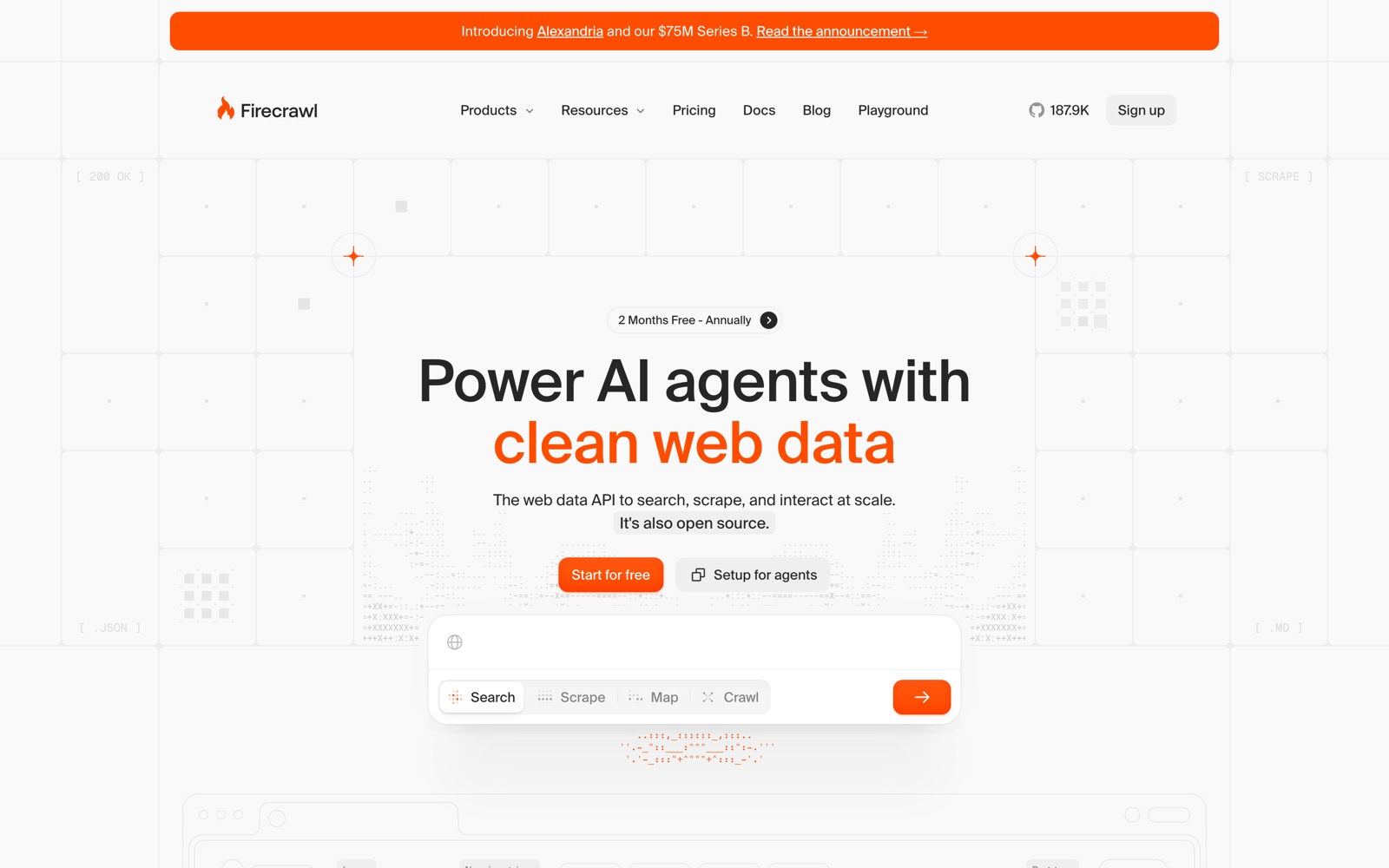
Firecrawl turns web pages into text a language model can use. You send a URL and get back the page as Markdown with navigation, footers and ads stripped out. You can also ask for HTML, a screenshot, or JSON shaped by a schema or a prompt. That’s the scrape endpoint, and it’s the one most people start with.
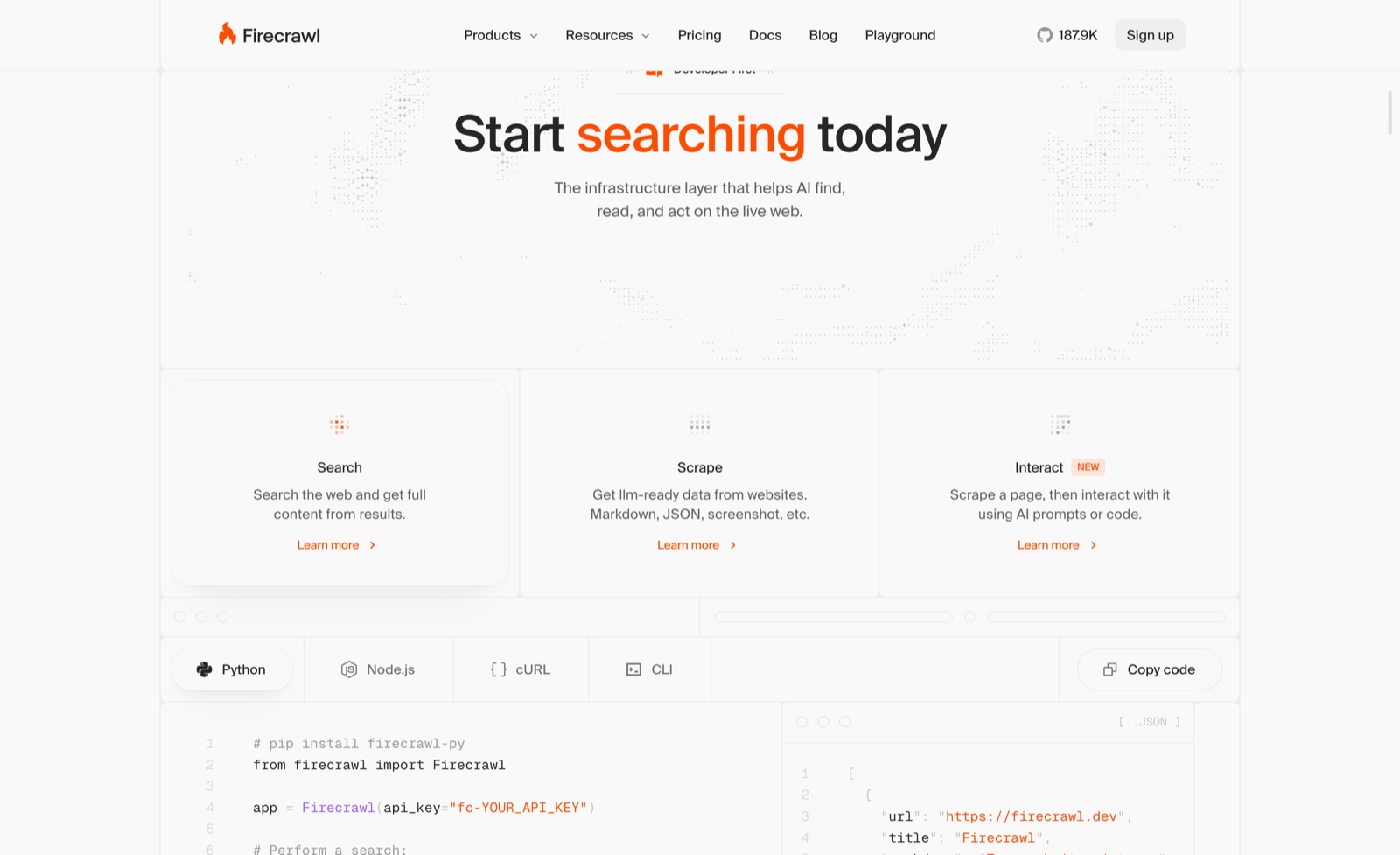
Around it sit four more. Crawl follows a site’s links and returns every page. Map lists every URL it can find on a site, which is cheap and useful for deciding what to crawl. Search runs a web query and scrapes the results, so your agent gets full page content instead of ten blue links and snippets. Interact, the newest, keeps a browser open so an AI prompt or your code can click, type and scroll before the scrape.
The point of all this is that you don’t run browsers. Before tools like this, getting a JavaScript-heavy page into an LLM meant Playwright or Puppeteer, a proxy pool, retry logic, and an HTML-to-Markdown step that never quite worked. Firecrawl does that work on its servers and bills you per page.
It sits in an odd spot on the map. Compared with Apify it’s one general API rather than a store of site-specific scrapers. Compared with Tavily or Exa it’s more of a scraper with search attached than a search engine with page contents attached. And compared with Crawl4AI it’s the hosted version of something you could run yourself.
How Firecrawl works
A request goes in with your API key, or without one at lower limits on the keyless tier. Firecrawl loads the page in a real browser, renders JavaScript, waits for content to settle, and parses PDFs and Word files the same way. Then it cleans the output. Firecrawl claims its Markdown uses 93% fewer input tokens than raw HTML, which is the vendor’s figure, but the direction is obviously right: navigation and cookie banners are tokens you pay your LLM for.
For structured data you pass a JSON schema or a plain-English prompt and get fields back. That step runs an LLM on Firecrawl’s side, which is why it costs 4 extra credits per page. Long crawls report back through signed webhooks; short requests return in the response.
The part that has changed fastest is the agent tooling. There’s an MCP server at mcp.firecrawl.dev that Claude Code, Codex, Cursor and OpenCode can add with one line, a CLI that installs Firecrawl “skills” into every coding agent it finds, and native connectors for ChatGPT and Claude.ai. The homepage even carries an onboarding file written for AI agents to read.
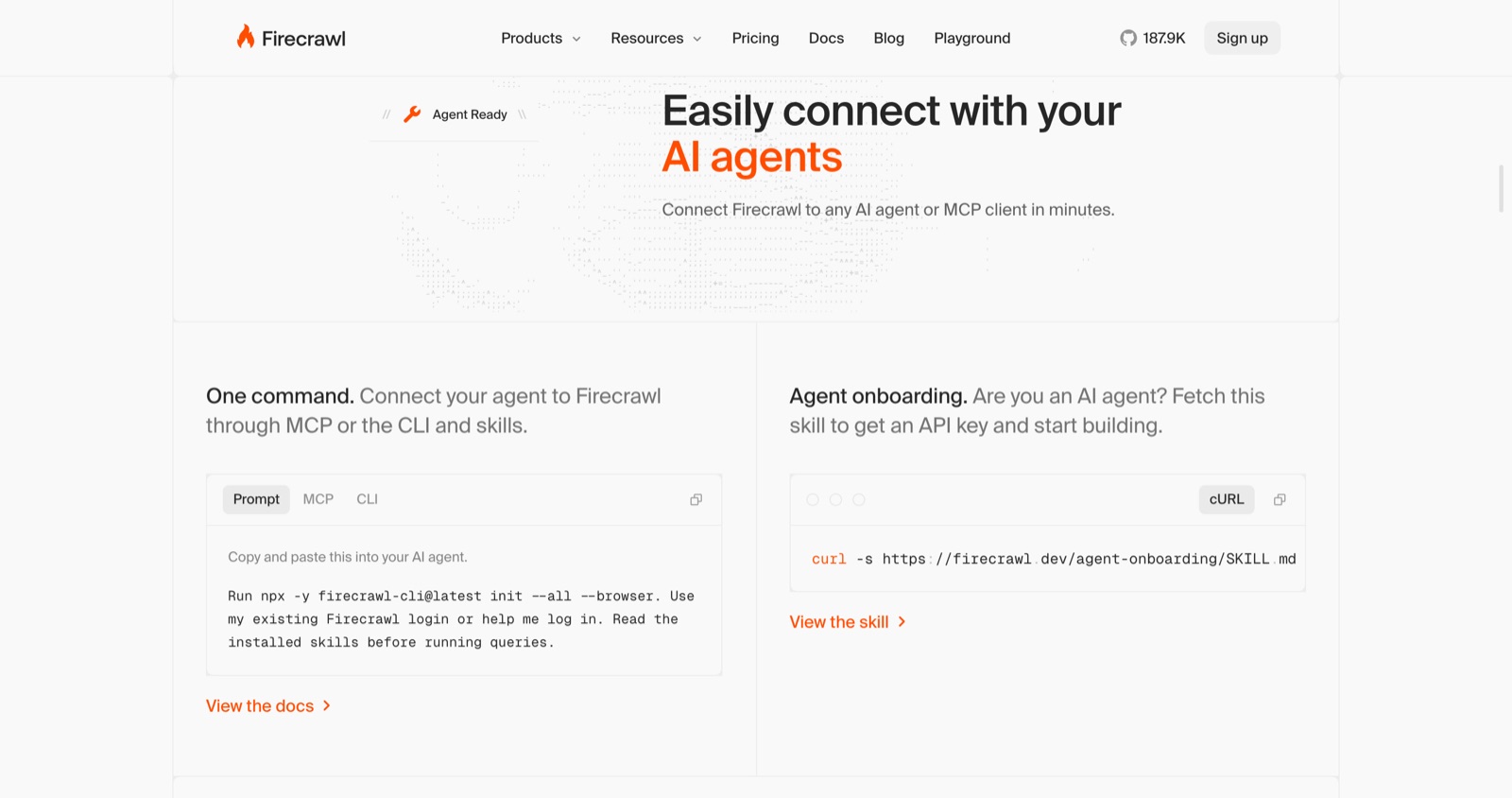
We think this is the strongest argument for Firecrawl in 2026. If you live in Claude Code or Cursor, giving your agent the ability to read current docs or a competitor’s pricing page takes a minute, and the keyless MCP server exposes search, scrape and parse without an account. Firecrawl’s June 2026 launch post says every developer gets 1,000 free credits a month that way, no signup needed.
A caveat from our side: when we tried a keyless scrape on October 2, Firecrawl answered with a 403 saying our IP address “looks suspicious” and asked us to sign up for a free key. That’s one request from one network, so don’t read too much into it. But if you’re planning a demo or workshop around the no-key route, get a free key first.
Is Firecrawl reliable and fast?
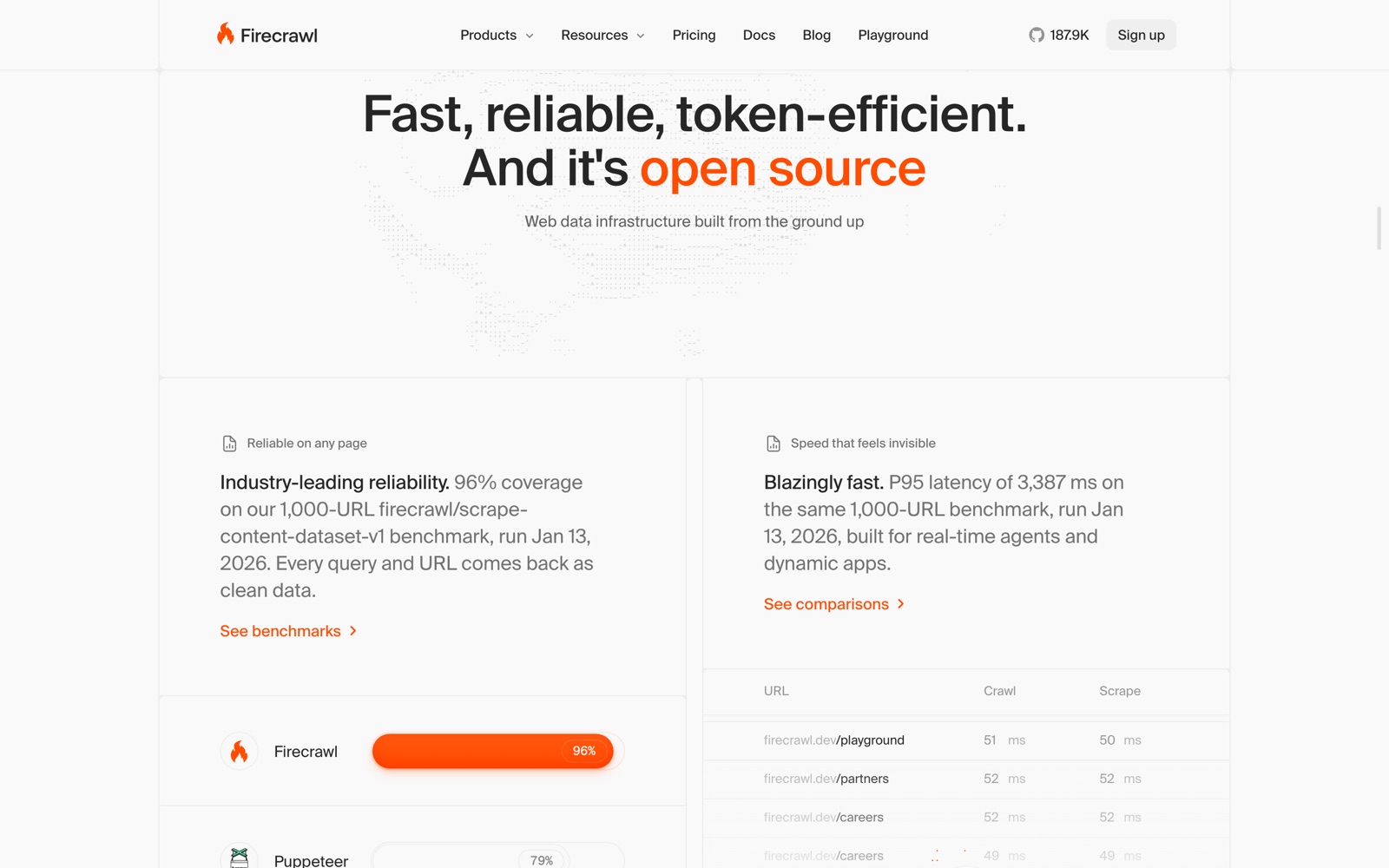
Firecrawl publishes its own benchmark: 96% coverage on a 1,000-URL dataset run on January 13, 2026, against 79% for Puppeteer and 75% for plain cURL, with a P95 latency of 3,387 milliseconds. It’s a vendor test on a vendor dataset, so treat it as a claim.
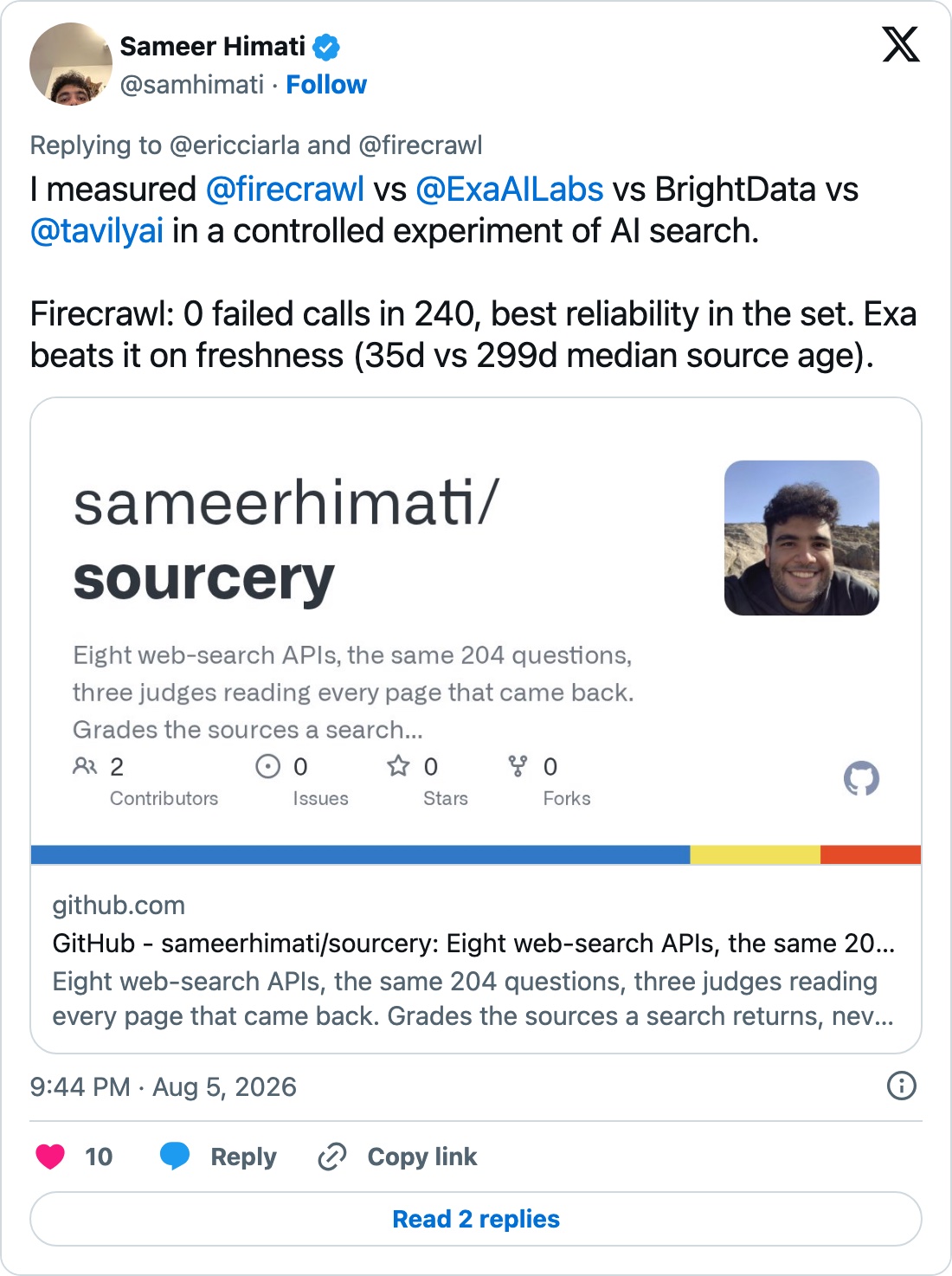
The independent evidence we found points the same way on reliability and the other way on freshness. One developer ran a controlled comparison of AI search tools in August 2026 and reported Firecrawl had zero failed calls out of 240, the best reliability in the set, while Exa returned fresher sources.
On Reddit the recurring caveats are speed and the hardest bot protection. A commenter in r/LocalLLaMA called it “the best for agents” but added that “it can be very slow though”, and another said Cloudflare Turnstile is where it “still struggles”. A Hacker News thread from December 2025 was titled “Firecrawl getting blocked due to headlesness”. None of that is surprising for any scraper, but it means you should test your hardest target sites on the free plan before you commit.
We also saw promotion dressed up as evidence, in both directions. A glowing r/LocalLLaMA thread about Firecrawl had its own commenters calling it a “bot swarm”, and two “benchmarks” on X that rank Firecrawl badly came from accounts promoting rival tools. We didn’t use any of them.
A real job: giving a research agent live web access
Here’s the workflow Firecrawl is built for, using its own documented pieces. Suppose you have an agent that answers questions about competitors: what they charge, what they shipped this month, how they position themselves.
- Connect the agent. In Claude Code,
claude mcp add --transport http firecrawl https://mcp.firecrawl.dev/v2/mcp, then add your API key as a bearer header once you outgrow keyless. - Search, don’t guess URLs. The agent calls search for “
pricing”, which returns full page content for each result at 2 credits per 10 results. - Map before you crawl. For a competitor’s docs or changelog, map lists the URLs for 1 credit per page found, so the agent crawls only the pages that changed.
- Extract the fields you care about. Ask for JSON with plan names, prices and limits. This is the 5-credit step, so keep it to pages that matter.
- Watch for changes. Monitor re-checks pages on a schedule and flags meaningful changes; its deterministic extraction bills a flat 7 credits per page per check.
In credits, a weekly sweep of 10 competitors (one search, a 20-page crawl and 5 JSON extractions each) is about 2 + 20 + 25 = 47 credits per competitor, or roughly 470 a week. That fits in the free tier for a month or two of testing and comfortably inside Hobby after that. A Reddit user in r/AI_Agents described a similar build that “tracks about 290 companies in the news for a VC”, which is the scale where Standard starts to make sense.
If you want an agent that acts on this research for you instead of just reading it, our Squad review covers AI teammates that run recurring jobs like this on a schedule, and the AI builders stack puts Firecrawl next to the other tools in that kind of setup.
Firecrawl with n8n, ChatGPT and other tools
You don’t have to write code to use Firecrawl. It’s a native integration in n8n: on n8n Cloud you install the Firecrawl node and click Connect, and Firecrawl’s own blog lists three official starter templates (RAG ingestion into Pinecone, Supabase vector storage, and company lead enrichment). r/n8n is the third busiest subreddit in our Reddit sample, with 13 threads naming Firecrawl in the past year, and the questions there are practical: which node to use, how to handle long crawls, and what to do about credits.
If you self-host n8n, you can call the REST API from an HTTP Request node instead, which is what the r/n8n user who complained about expiring credits was doing. The same pattern works in any automation tool that can send a POST request.
On the chat side, Firecrawl became an official ChatGPT plugin in August 2026 and an official Replit connector in July, and it has plugins for Codex and a keyless search option in OpenCode. Firecrawl posted on September 30 that it was the sixth most popular plugin in ChatGPT, which is its own claim. For you, the practical upshot is that the same account and credits work across your coding agent, your chat assistant and your automations.
The thing to watch is that each surface spends from the same pool. An n8n workflow that runs every hour, a coding agent reading docs all day and a teammate using the ChatGPT plugin can drain a Hobby plan in a week without anyone noticing. Set a pay-as-you-go cap, or give each project its own key and team, before you connect everything.
What Firecrawl really costs
The pricing table is simple. What you’ll pay isn’t, because everything runs on one pool of credits and different jobs drain it at different rates.
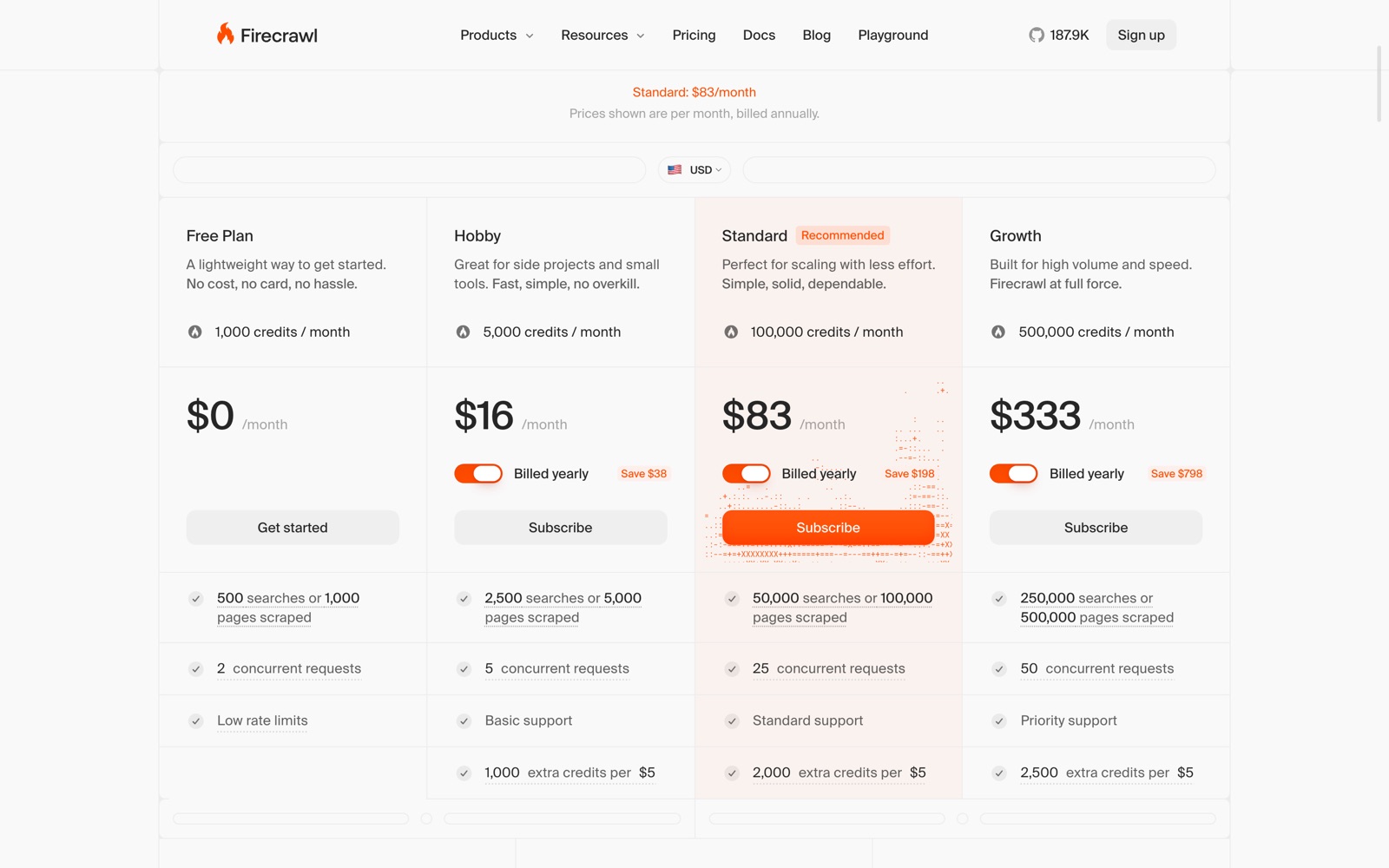
| Plan | Monthly | Yearly (per month) | Credits | Per basic page | Concurrent |
|---|---|---|---|---|---|
| Free | $0 | $0 | 1,000 | – | 2 |
| Hobby | $19 | $16 | 5,000 | $0.0038 | 5 |
| Standard | $99 | $83 | 100,000 | $0.00099 | 25 |
| Growth | $399 | $333 | 500,000 | $0.0008 | 50 |
| Scale | $749 | $599 | 1,000,000 | $0.00075 | 100 |
Then the multipliers. A basic scrape, crawl or map page is 1 credit. Search is 2 credits per 10 results. Interact is 2 credits per browser minute. And the JSON, Question and Highlight formats add 4 credits per page.
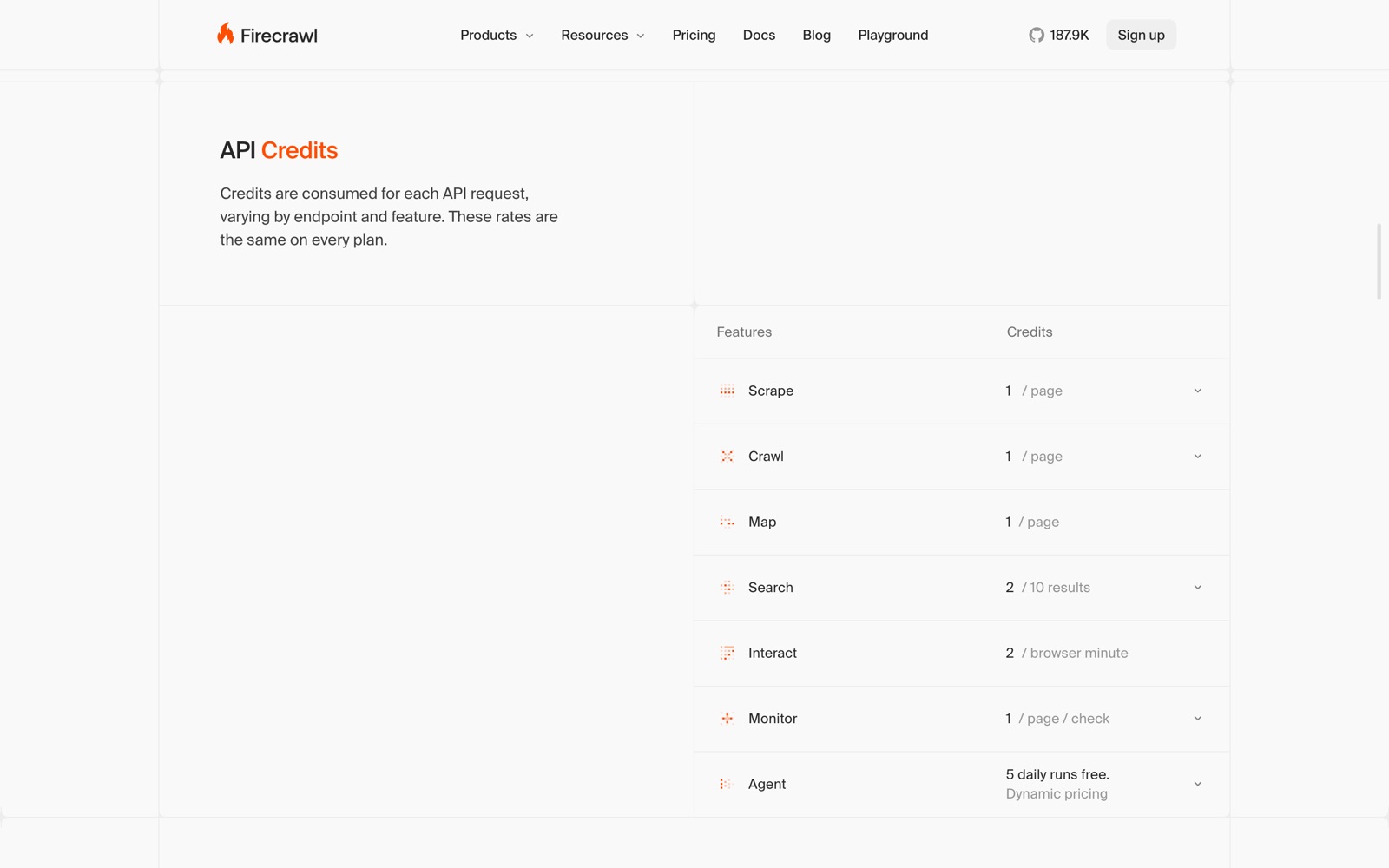
The two numbers that decide your bill are the 4-credit JSON surcharge and the fact that unused credits disappear at the end of the month on every plan below Scale. A few budgets, worked out from the pricing page:
- Side project, 3,000 pages a month, Markdown only: Hobby at $19 covers it with room to spare. The free plan’s 1,000 credits won’t.
- 20,000 pages a month with JSON on every page: that’s 100,000 credits, so Standard at $99. Without JSON it would fit in Hobby plus a few top-ups.
- Hobby plus top-ups vs Standard: pay-as-you-go on Hobby buys 1,000 credits per $5, or $0.005 a page. At about 21,000 pages a month, Hobby plus top-ups costs more than Standard’s flat $99.
- Bursty agent, 50,000 pages one month and almost nothing the next two: you either pay Standard for three months ($297) or keep switching plans. This is the case people complain about.
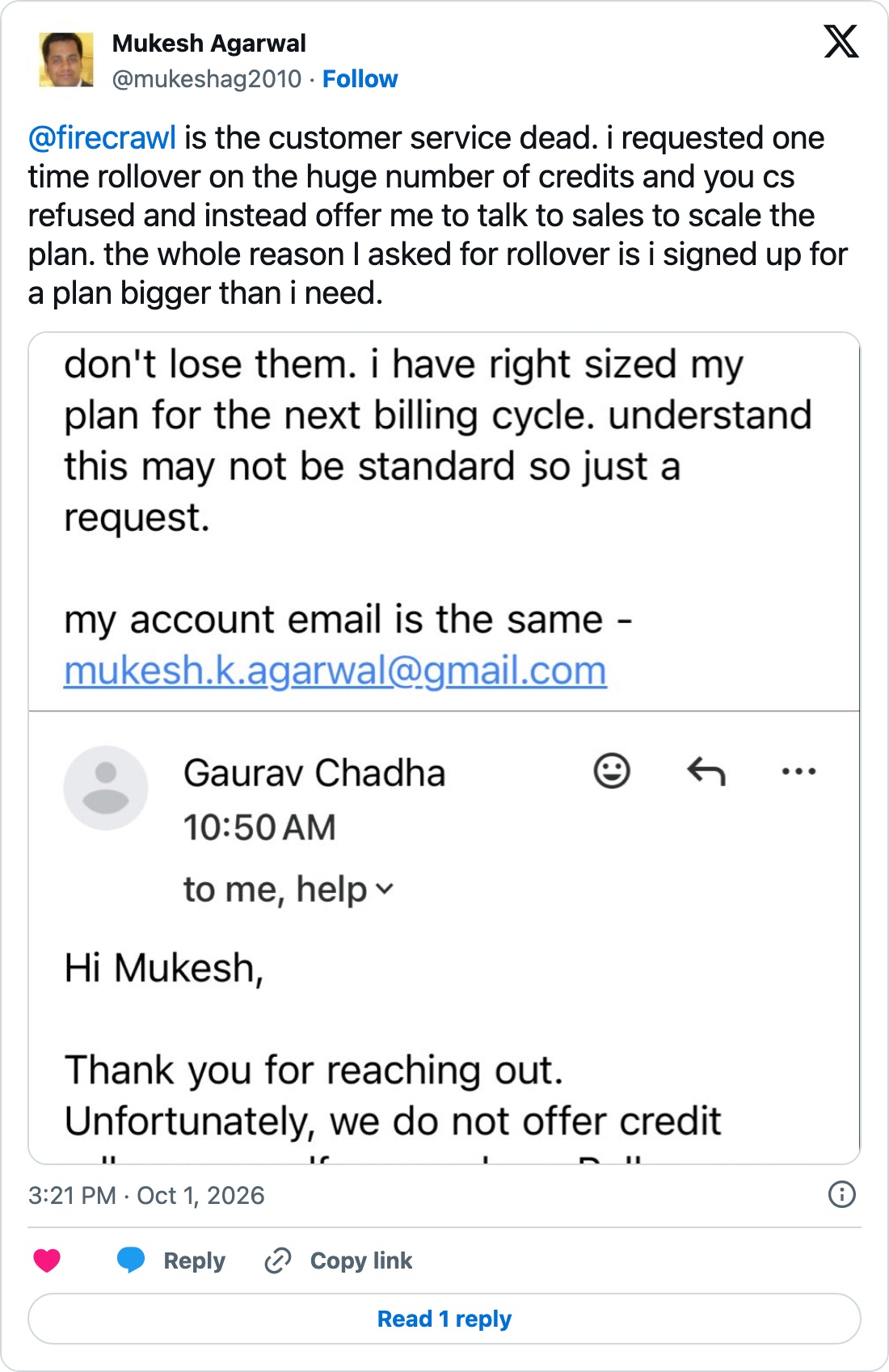
That last case is the most common gripe we found. A user in r/n8n put it bluntly: “my unused credits just vanish at the end of the month”, and the thread filled with suggestions for prepaid-credit services and self-hosted Crawl4AI. On X, a paying customer complained on October 1 that support refused a one-off rollover after they’d picked a plan bigger than they needed.
Firecrawl has softened this a little. Since September 9, 2026, paid plans can top up automatically in $5 blocks up to a monthly cap you set, and credits you buy that way stay until used (unless you cancel). It doesn’t fix expiry of the plan’s own credits, but it means you can pick a smaller plan and top up in heavy months instead of overbuying.
Two smaller billing details are worth knowing before you budget. A scrape that returns nothing isn’t charged, but a page that answers 403 or 404 still costs a credit, so crawling a site full of dead links costs money. And there’s no refund policy on the pricing page; read the terms before you pay for a year.
Which Firecrawl plan should you pick?
Pick by measured credits, not by pages. Run a week of your real workload on the free plan, read the credits used in the dashboard, multiply by four, and add a margin for JSON pages and searches. Then:
| Your monthly credit use | Plan we’d pick | Why |
|---|---|---|
| Under 1,000 | Free | Enough for testing, a personal agent or a weekly report |
| 1,000 to 5,000 | Hobby, $19 (or $16 yearly) | Cheapest paid plan; adds pay-as-you-go for heavy weeks |
| 5,000 to about 20,000 | Hobby plus top-ups, with a cap | Top-ups cost $5 per 1,000 credits; still under Standard’s $99 |
| 20,000 to 100,000 | Standard, $99 (or $83 yearly) | Per-page cost drops to about $0.001, and 25 concurrent browsers |
| 100,000 to 500,000 | Growth, $399 | Shared Slack channel and higher rate limits |
| Bursty, over 500,000 some months | Scale, $749, or self-host | The only self-serve plan where unused credits carry over |
Yearly billing saves 16.7% on Hobby to Growth and 20% on Scale. We’d only take it after two or three months of steady use, because you’re committing to a credit allowance that still expires monthly. And if your workload is mostly search for an agent rather than scraping, price Tavily and Exa before you choose; we cover both below.
Can you self-host Firecrawl?
Yes, and it’s one of the reasons Firecrawl got popular. The repository is AGPL-3.0, and the docs walk through a Docker Compose setup pinned to a specific release that starts the API on port 3002. You pay for servers and, if you want JSON extraction, for an LLM provider of your own (any OpenAI-compatible API or a local model through Ollama).
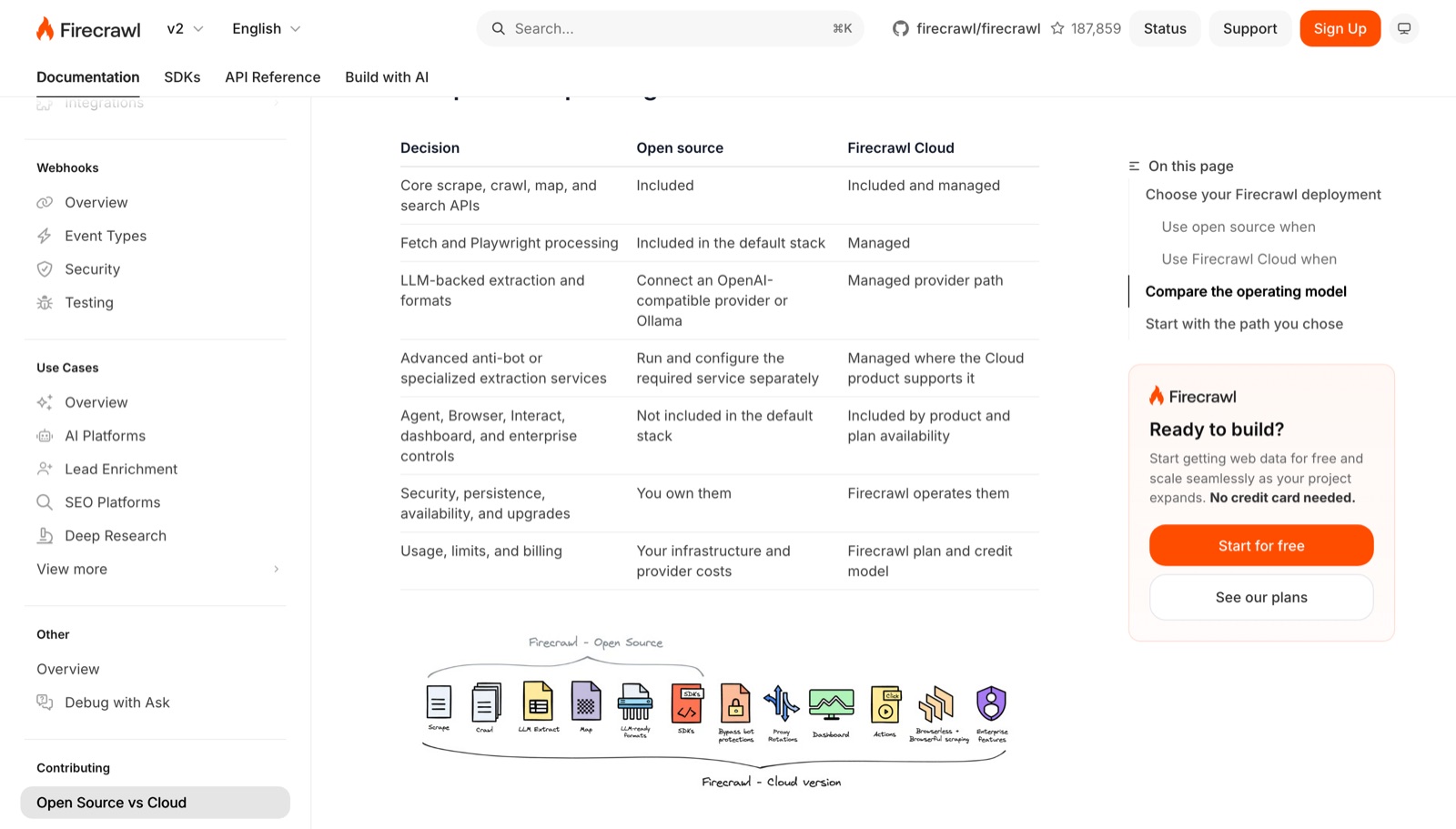
The self-hosted version is not the same product, and Firecrawl says so plainly. The quickstart turns authentication off and has no TLS or durable storage, so you’ll need to add those before exposing it. Agent, Browser, Interact, the dashboard and the managed anti-bot paths aren’t included. Hacker News is full of people who decided that trade wasn’t worth it and built lighter forks and rewrites, from “Firecrawl-Simple” in 2024 to single-binary Rust alternatives in 2026.
Self-host if you have steady volume and someone who enjoys running infrastructure; otherwise the Cloud plans are cheaper than your time. The AGPL license also matters if you modify the code and offer it as a service to others, so check it with whoever handles licensing at your company.
What Firecrawl shipped in 2026
Firecrawl changes quickly, which is good for features and a reason to re-check prices before you buy. In the last few months alone it launched the keyless tier (June 16), a web-scale version of Monitor (July 1), the Replit connector (July 23), the ChatGPT plugin (August 5), pay-as-you-go top-ups (September 9) and Alexandria with the $75M Series B (September 22). The current pricing table says it took effect on September 4, 2026, and older blog posts about Firecrawl quote plans and credit costs that no longer exist.
Two practical consequences. First, any review older than a few months, including third-party “Firecrawl pricing” pages, may be wrong about what you’ll pay; trust the vendor’s pricing page and the date on it. Second, the newest endpoints (Interact, Monitor, Agent) have their own credit rates, and Agent is still in preview with “dynamic pricing” and five free runs a day. Build your core workflow on scrape, crawl, map and search, and treat the rest as experiments until their pricing settles.
Security, data and legality
For a tool that fetches pages on your behalf, Firecrawl’s paperwork is solid. Every plan, including Free, lists SOC 2 Type II, regular penetration testing, MFA, signed webhooks and PII redaction. Standard and up get a data processing agreement. Zero data retention, SSO, SCIM, IP-restricted API keys and static egress IPs are Enterprise-only, which matters if you scrape anything sensitive or need a fixed IP for a partner’s allowlist.
Legality is the question people search most after price (“is firecrawl legal”). Firecrawl is a tool, and using it is legal; scraping a particular site may not be, depending on that site’s terms, robots rules, whether the data is personal, and where you are. Firecrawl doesn’t make that decision for you. What’s changed is that it now sells a licensed route as well: with its September 2026 Series B it launched Alexandria, which pulls from official data providers and pays some of them, Wikimedia Enterprise included. If you’re building something commercial on top of other people’s content, that route is worth a look.
The catch
- Credits expire. Free, Hobby, Standard and Growth reset every month. Only Scale ($749) rolls over, for one month.
- Structure costs five times as much. JSON, Question and Highlight output add 4 credits to every page, so “extract these fields from 10,000 pages” is a 50,000-credit job.
- Hard sites are still hard. Users report slowness and blocks on the toughest bot protection, like Cloudflare Turnstile. Test your real targets first.
- The free key route isn’t guaranteed. Our keyless request was refused as a suspicious IP. Plan on a free account.
- Self-hosting is a different product. No Agent, Browser, Interact or managed anti-bot, and production setup is on you.
Firecrawl alternatives
The tools people name next to Firecrawl, priced from their own pages on October 2, 2026:
| Tool | Free tier | Paid entry | Better than Firecrawl when |
|---|---|---|---|
| Crawl4AI | Free, open source (Apache-2.0) | Your servers | You can run browsers yourself and hate monthly credits |
| Apify | $5 of usage a month | $19/month plus $0.13–$0.20 per compute unit | A maintained scraper already exists for your exact site |
| Tavily | 1,000 API credits a month | $0.008 per credit pay as you go | You mainly need search results for an agent, not full crawls |
| Exa | $10 of credits a month | Search from $4 per 1,000 requests; contents $1 per 1,000 pages | You need fresh, semantic search with page contents |
Crawl4AI is the one Reddit recommends most when people complain about Firecrawl’s pricing. It’s a Python library, also aimed at LLM-ready Markdown, with about 85,000 GitHub stars. You get no credits and no bill, and you also get every browser, proxy and scaling problem yourself. It now has a hosted cloud too, with credits that never expire; we set the two side by side in Firecrawl vs Crawl4AI.
Apify is the incumbent for scraping as a business. Its store has ready-made scrapers for specific sites, and its pricing is prepaid usage plus compute units, which one Reddit user said “crept up fast once i started scraping at any real volume”. The head-to-head is on Firecrawl vs Apify.
Tavily and Exa are search APIs first. In an r/AI_Agents thread about the “gold standard” for agentic scraping, one builder said Tavily was working best for them, with Firecrawl as a backup. If your agent mostly searches and reads, price those two against Firecrawl’s search at 2 credits per 10 results.
You’ll find every option we’ve reviewed on Firecrawl alternatives and in our web scraping category, and the full reference page with setup steps, use cases and an FAQ is at Firecrawl on minylist.
Who should use Firecrawl?
Try it if you’re a developer or AI builder putting live web pages into an LLM app, RAG pipeline or agent, and your volume is steady enough to use most of a plan each month. It’s also an easy pick if you work in Claude Code, Cursor or Codex and want your agent reading the web in a minute. Start on the free 1,000 credits, run your hardest target sites through it, and count how many credits your real workload uses before choosing a plan.
Skip it if your jobs come in bursts with idle months in between, if you need JSON from huge numbers of pages (the 5x multiplier adds up), or if you’d rather run Crawl4AI on a server you already pay for. And if one ready-made Apify scraper already covers the single site you care about, use that.
Our verdict: Firecrawl is the easiest way to give an AI agent clean web data, and the free tier is enough to prove it; just size your plan from measured credit use, not page counts. We rate it 3.9 out of 5 from public pages, held back mainly by the credit model.
For the rest of the tools we’d pair it with, see the AI builders stack.





 ChatGPT
 Claude
 Perplexity
 Grok
Grok